

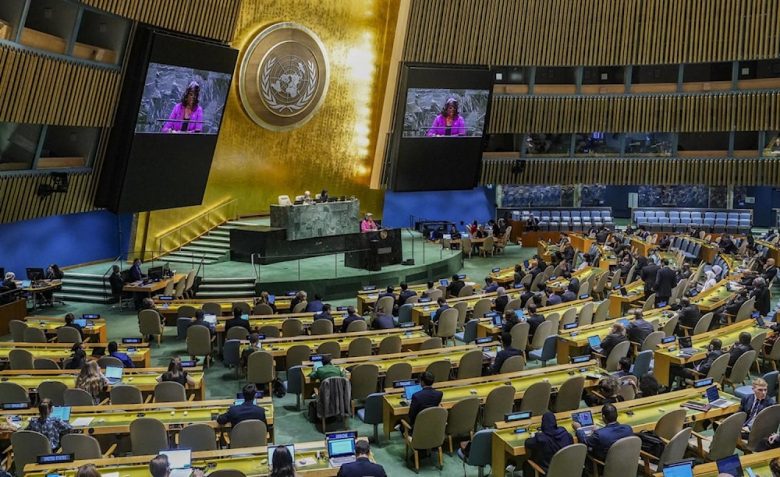
The Sahrawi issue returns to debate at the United Nations following the recent deadlock in the Security Council. Indeed, the United Nations General Assembly will hold a plenary session next Tuesday in New York to examine the use of the veto against two Security Council draft resolutions on Western Sahara.
According to the UN justifying the holding of this meeting, this session is scheduled by General Assembly resolution 76/262, adopted in 2022. It stipulates that after the exercise of a veto by a permanent member of the Security Council, the Assembly shall meet within ten working days so that member states can debate the concerned issue, unless an emergency special session is already devoted to the topic.
The summoning of General Assembly members follows the vetoes cast on Friday, during a Security Council session devoted to the situation in Western Sahara. According to the transmitted text, Russia blocked an American draft referencing a solution based on autonomy, while the United States subsequently vetoed a Russian draft providing for the extension of the mandate of the United Nations Mission for the Referendum in Western Sahara (Minurso) and the continuation of political consultations between the parties.
With the diplomatic stalemate, and lacking the adoption of a text to clarify the future of the Minurso mandate, observers worry about the continuation of the UN mission and the future of the political process in Western Sahara.
According to reports, this session on November 10 will allow member states to make known their positions on the vetoes and their consequences. Washington and Moscow could also explain the motives behind their votes, while several countries are expected to reiterate their positions on the political process and the future of Minurso.
It must be recalled that the General Assembly lacks the power to overturn a veto, renew the mandate of the mission, or substitute itself for the Security Council. It is merely a broader debate forum regarding a decision and the general situation in this occupied territory.
In a fresh reaction to this intelligence, the Polisario Front presents the gathering as an opportunity to place Western Sahara back at the center of international discussions. It considers that the debate could transcend the framework of the Security Council and allow member states to express themselves on recent developments.
The Polisario text also recalls that the Fourth Committee of the General Assembly, tasked with decolonization questions, adopted on October 15 a draft resolution on the territory. According to this declaration, the text reaffirms its status as a non-self-governing territory and the right to self-determination of the Sahrawi people.
It calls to preserve United Nations references and to foster the resumption of a negotiation process aiming toward a lasting political solution.
For his part, the ambassador of the Sahrawi Republic in Algeria, Khatri Addouh, asserted that the attempts of the Moroccan occupier aiming to liquidate the Sahrawi cause and distort its legal and lawful status have been doomed to failure, stressing that the Sahrawi people will continue their struggle to snatch their inalienable right to self-determination and independence.
During a conference held in Algiers, Khatri Addouh stressed that the non-adoption by the Security Council of the draft aiming to undermine the legal foundations of the Sahrawi cause confirms the international community attachment to its UN reference, the question of Western Sahara being considered a decolonization issue, and reaffirms the Sahrawi people right to self-determination.
The Sahrawi diplomat advocated for the pursuit of a serious decolonization process of Western Sahara that will allow the Sahrawi people to exercise their inalienable right to self-determination and independence.