

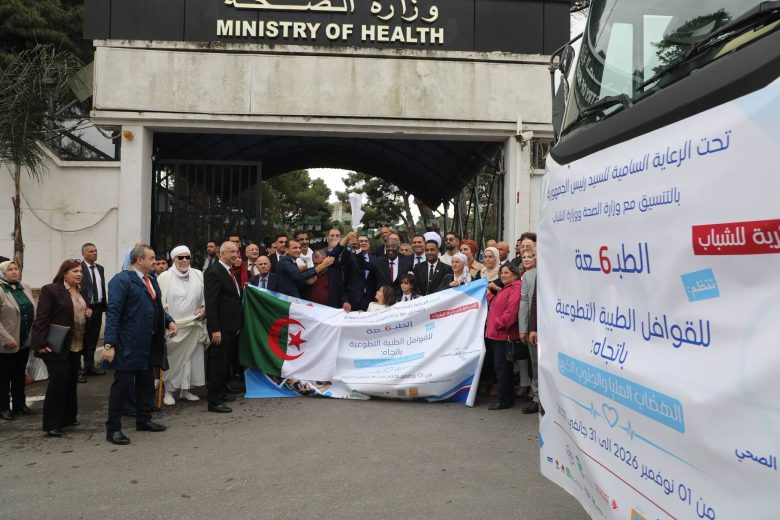
The sixth edition of volunteer medical caravans was launched, Monday, from Algiers under the high patronage of President of the Republic Abdelmadjid Tebboune. Scheduled to run through late January 2027, this initiative foresees interventions across several provinces in the South and High Plateaus, placing special focus on populations in isolated and border zones.
The kickoff of this sixth edition, held under the slogan “Together to Expand Healthcare Provision,” was overseen by Minister of Youth, in charge of the Supreme Council of Youth, Moustafa Hidaoui, alongside Minister of Health Mohamed Seddik Aït Messaoudène.
Initiated by the Algerian Youth Network in coordination with both ministerial departments and supported by public and private enterprises, the rollout includes a mobile medical clinic, ambulances, along with dozens of physicians and medical department heads. Teams will navigate multiple municipalities to supply consultations and diverse healthcare services directly to residents.
During his address, Hidaoui commended youth engagement across diverse sectors and their contribution to state efforts, particularly within public health. Emphasizing that “this initiative reflects national solidarity values and synergy between civic associations and state institutions,” he specified that “it embodies the shared determination to reach the country’s most remote regions and secure healthcare delivery for their residents.”
The minister further highlighted initiatives undertaken to invest in youth competencies, enabling civic organizations to perform their full role in supporting national action. On this note, he underscored the importance of leveraging performance metrics to evaluate initiative outcomes and enhance field efficiency.
For his part, Aït Messaoudène highlighted the medical and human reach of this deployment, stating that “beyond the sheer volume of interventions performed, these caravans deliver tangible health and human impact.” He added that “they demonstrate how volunteer projects, when integrated into structured institutional partnerships, yield real and lasting benefits for healthcare delivery.”
The minister additionally announced continuing and broadening this approach through a field program spanning numerous regions and municipalities throughout the High Plateaus and the South. In this context, he stressed the value of partnering with civil associations, viewing them as “a crucial partner in executing national health policies,” given their ability to maintain direct contact with citizens, comprehend local needs, and reach specific social groups and regions requiring targeted care.
Ensuring Follow-Up Beyond Initial Consultations
Aït Messaoudène detailed strategic directions chosen to advance this collaboration, explaining that priority lies in reinforcing institutional partnerships with civic entities and civil society actors, stepping up prevention, awareness, and early screening initiatives, while directing focused attention toward border, isolated, and vulnerable groups.
The minister also emphasized the imperative of “continuous medical tracking and coordination among mobile medical teams, local healthcare facilities, and regional referral hospitals.” Maintaining that “this structure must ensure care does not stop at initial consultations,” but encompasses diagnosis, treatment, and ongoing patient monitoring. “Citizen health remains central to state priorities,” he reiterated, maintaining that equitable healthcare access requires sustained field commitment, pooled efforts, and a deepened sense of responsibility and solidarity. He concluded his speech calling for joint efforts toward “healthcare closer to citizens, reinforced solidarity, and broader engagement.”
Within this framework, the program schedules interventions across several municipalities and localities, including El Aricha, In Guezzam, Bordj Badji Mokhtar, Timimoun, Bir El Ater, Béchar, El Meniaa, Naâma, Laghouat, Médéa, and Mila. These journeys will enable medical teams to reach communities whose geographic isolation occasionally hampers access to healthcare infrastructure.
On his end, President of the Algerian Youth Network Adel Gana praised the attention devoted to youth by the President of the Republic. He highlighted successive editions of this operation, presented as a model of participatory solidarity bringing together the health sector, state bodies, civic movements, and economic operators. Notably, beyond conducting on-site consultations, this sixth edition aims to strengthen links between mobile medical teams and local health structures to extend patient care well past initial visits.