

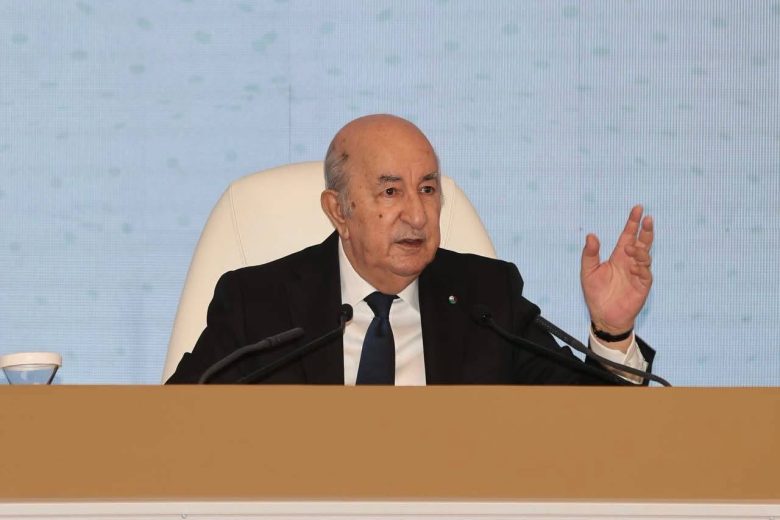
President of the Republic Abdelmadjid Tebboune highlighted the strategic role of natural gas, asserting that it is not a temporary option, but a lasting pillar of national economies. He called for unifying the Forum’s voice, consolidating its role, and strengthening cooperation to guarantee market stability and supply security in the face of geopolitical tensions. Highlighting Algeria’s pioneering role in the gas industry, the President reiterated Algeria’s position as a provider that has been and will remain a safe and reliable supplier.
In his speech read on his behalf by Prime Minister Sifi Ghrieb at the opening of proceedings for the 8th Summit of Heads of State and Government of the Gas Exporting Countries Forum (GECF), held Tuesday in Moscow, Russia, President Tebboune referenced the decisive turning point for global energy markets in which this summit takes place. He affirmed that the gas industry has demonstrated its resilience and that natural gas is not a fleeting temporary option, but a lasting pillar of national economies.
Evoking the “Algiers Declaration” that concluded the 7th GECF Summit hosted by Algeria in 2024, which he noted consecrated the strategic position of natural gas within the global energy security system, Tebboune urged the consolidation of the Gas Exporting Countries Forum’s role. The current context demands consolidating the role of our Forum and strengthening cooperation among its members to guarantee market stability and supply security amid geopolitical tensions, he stated, calling for a unified Forum voice to defend shared interests and expand gas presence into new markets within the framework of South-South cooperation. He thus stressed the necessity of carrying a unified vision for coming decades, grounded in safer and cleaner gas, a more stable market, and a more present and influential Forum.
Tebboune, who also returned to the evolution of the gas industry caught between energy security imperatives and climate transition requirements, noted the impact of regulatory instability. This situation accentuates market disruptions, curbs investments, and exposes supply security to risks, he noted, underlining the need to establish stable regulatory frameworks. Injecting billions of dollars into gas infrastructure requires stable regulatory frameworks and a fair valuation of gas, particularly within long-term contracts, the President emphasized, calling for constructive dialogue leading to a consensual regulatory framework that guarantees investment security and directs capital toward regions needing it most.
=== Natural Gas as a Partner to Renewable Energies
In his address to representatives of gas-exporting nations at the 8th GECF Summit under the presidency of Russian President Vladimir Putin, the Head of State indicated how energy transition must proceed. The transition must be just and progressive, Tebboune affirmed, highlighting the role natural gas must play in this shift.
Natural gas appears as a natural partner to renewable energies, he observed, noting that this energy source guarantees electrical system stability, contributes to emission reductions, and avoids returning to more polluting energy sources. He consequently affirmed that natural gas is not an obstacle to energy transition, but a bridge allowing it to be successfully conducted in complete safety.
Regarding global energy security, the President stated that it rests upon an indivisible balance between predictable demand, guaranteed supplies, and fair remuneration commensurate with resource value and investment volume. This balance must ensure supply sustainability and reconcile economic and social development requirements with climate targets, while taking into account the principle of common but differentiated responsibilities and respective national capacities, he affirmed. A challenge that cannot be met without technology and innovation, which is why he called on the Forum, through its Gas Research Institute, to play a larger role in disseminating technologies for emission reduction, carbon capture, utilization, and storage, as well as enhancing energy efficiency through digitalization and artificial intelligence.
=== Algeria Will Remain a Safe and Reliable Supplier
Tebboune further revisited Algerian experience in the gas industry and the ongoing role the country performs on the global energy stage. Algeria has been and will remain a safe and reliable supplier, he assured, demonstrating that the country stands as a pioneer in the gas industry since constructing the world’s first natural gas liquefaction complex in Arzew in 1964. He also pointed out that Algeria ranks among the top ten global gas producers and is the second-largest supplier to the European Union via pipeline, while supplying numerous countries worldwide with liquefied natural gas (LNG).
These achievements stem from a reliability that has never faltered, even in the most difficult circumstances, and constant respect for our commitments, the President welcomed, affirming that the country now moves resolutely forward in implementing an ambitious, equitable, and organized energy transition strategy. This strategy will reconcile climate imperatives, national sovereignty, and energy security, Tebboune explained, stating that the ambition is not to suffer the energy transition, but to define its contours ourselves. The President of the Republic did not fail on this occasion to recall major structural projects launched by Algeria, such as Gara Djebilet and the integrated phosphate project, alongside continental initiatives like the Trans-Saharan Gas Pipeline project. Algeria’s ambition to become a major actor in the hydrogen domain through the South2 Corridor was also brought to light by the President.