

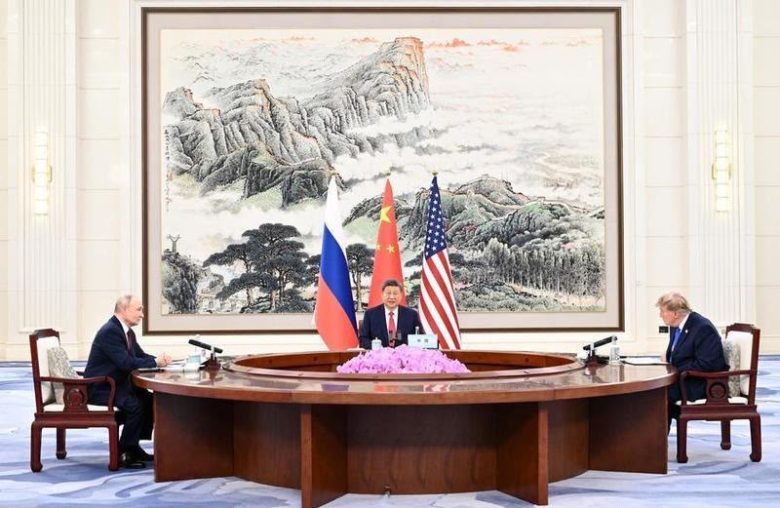
Eighty minutes around a dark boardroom table at the Kylin Villa in Shenzhen, in southern China’s Guangdong province, proved enough to usher global diplomacy into uncharted territory. On Thursday, on the sidelines of the Asia-Pacific Economic Cooperation (APEC) summit, Donald Trump, Xi Jinping and Vladimir Putin held the first face-to-face meeting in history between the leaders of the United States, China and Russia.
Announced on Monday morning by China’s Foreign Ministry—whose spokeswoman, Mao Ning, stressed the landmark nature of the talks, noting that the three heads of state would hold a wide-ranging exchange of views on safeguarding world peace and bolstering strategic stabilit.
The meeting, hailed by the US president as a moment in which the three powers were “making history”, closed with the adoption of a joint “Statement by the Heads of State of China, Russia, and the United States in Support of Peace”.
Beneath the veneer of newfound accord, however, lies a stark realignment of international power, rooted in hard-nosed great-power politics at the expense of traditional multilateralism.
The communique issued after the talks sets out a pragmatic agenda built around four concrete pledges, echoing the principles outlined earlier on Thursday by President Xi. The Chinese leader put forward four tenets on how major powers ought to conduct their relations and work together to preserve global peace, arguing that they must uphold mutual respect, peaceful coexistence, mutually beneficial cooperation, and dialogue and consultation.
First, in their capacity as permanent members of the United Nations Security Council, China, Russia and the United States pledged to champion UN reform so the organisation can respond more effectively to global challenges and fulfil its core mandate of maintaining international peace and security.
Second, on energy, the three nations announced plans to boost the output and supply of refined petroleum products for the benefit of all countries, while reaffirming the need to safeguard stable energy flows.
The third point delivers a pointed rebuke on the legal and institutional front: acknowledging that state consent and the immunity of government officials are of paramount importance, the three leaders agreed that the International Criminal Court (ICC) and similar bodies must not overreach their jurisdiction.
That language hands a welcome political shield to Mr Putin, who remains the subject of an arrest warrant from the Hague-based court, while Mr Trump railed against an international judiciary he cast as unaccountable.
Finally, the fourth pillar reaffirms that a nuclear war cannot be won and must never be fought, committing Washington, Beijing and Moscow to talks on reducing nuclear risks and curbing proliferation.
Beyond the formal pledges, each leader leaves Shenzhen with tangible political gains tailored to his domestic standing. For Mr Putin, the summit’s very occurrence marks a striking diplomatic breakthrough. Ostracised by the West for nearly five years over the war in Ukraine, the Russian president now stands squarely at the centre of the great-power family photograph, received as an equal and warmly described as a “friend” by Mr Trump during their forty-minute bilateral warm-up.
Mr Trump, nursing political bruises at home after his party’s drubbing in the recent US midterm elections, is banking on this diplomatic coup to project himself as a decisive dealmaker unafraid to engage adversaries head-on. As for Mr Xi, the summit’s host, he cements China’s status as an indispensable broker in world affairs while securing a calmer footing with Washington just weeks before their trade truce is due to expire in January 2027.
Yet this tactical convergence at the top has rattled traditional American allies left outside the Kylin Villa gates. The communique’s silence on active conflicts—from the war in the Middle East to Russia’s invasion of Ukraine—has revived fears of a “new Yalta”, in which the fate of smaller nations is carved up over their heads. In Kyiv, Ukrainian officials warned sharply against a three-way format that, by shutting Ukraine out of the room, risks emboldening Moscow to press on with its offensive.
Across Europe, where capitals fear strategic irrelevance in the shadow of a Trump-Putin rapprochement, the French foreign minister, Jean-Noël Barrot, struck a sceptical note, dismissing the notion that the three leaders had actually agreed on anything of substance.
Leaving Shenzhen immediately after the talks wrapped up, Mr Trump left behind the unmistakable impression of a world steered by an exclusive club of three nuclear powers, untethered from the rules and institutions forged after 1945. While the lack of a detailed timetable on arms control or regional flashpoints underscores the immediate limits of such personal diplomacy, the signal sent from southern China is clear enough : the defining bargains of the coming decade will increasingly be struck behind closed doors by a select few.