

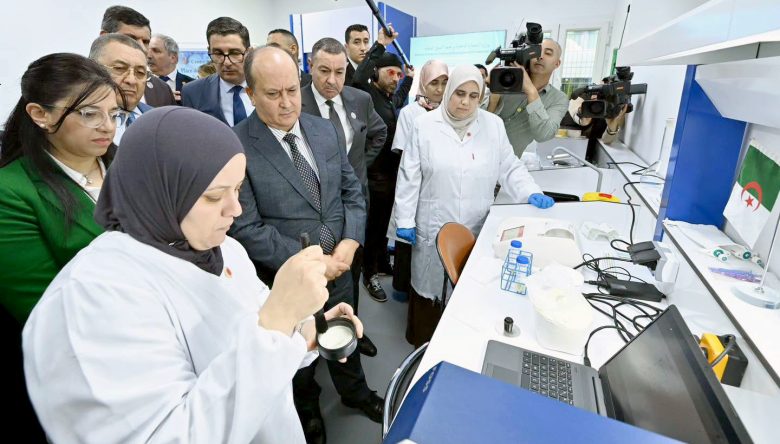
The reinforcement of imported goods inspections at borders will take shape through the establishment of 17 analytical laboratories located at ports, airports, and terrestrial border crossings. This operational system, designed to accelerate sanitary analyses and verify merchandise compliance prior to domestic market entry, will additionally reduce customs clearance times. The strategy was outlined Sunday by the Director of Laboratory Development and Monitoring at the Ministry of Internal Commerce, Yasmine Kemali.
This initiative follows directives issued by the President of the Republic during the Cabinet meeting on June 7, 2026, ordering the setup of border inspection laboratories for imported cargo. In an initial phase, two pilot facilities were constructed at the Port of Algiers and Algiers International Airport, following guidance from the Prime Minister.
Ms. Kemali emphasized that the goal is to cut analysis turnarounds and result delivery times, reinforce sanitary inspection and product compliance, and enhance coordination across involved administrative sectors. This approach primarily aims to safeguard consumer health and safety along with the national economy.
Within this context, she highlighted that fraud prevention agents possess expanded inspection prerogatives under Law 09-03 of February 25, 2009, regarding consumer protection and fraud suppression. They are thereby empowered to investigate and record infractions at border points as well as across the domestic market.
The legal framework establishes several enforcement measures against non-compliant products, notably including seizure, entry refusal, redirection, or destruction of goods, depending on their level of hazard.
Three Categories of Laboratories
Revisiting the execution roadmap, the official specified that an interministerial panel was formed on June 11, 2026, co-chaired by the Ministers of Commerce, Health, and Agriculture. This panel validated architectural designs and coordinated the transfer of rapid screening equipment. The construction of the pilot laboratories was assigned to the Ministry of National Defense upon instructions from the Prime Minister.
The development program relies on three distinct laboratory tiers. The first, designated Type A, addresses major maritime ports, specifically Algiers, Jijel, Skikda, Oran, Arzew, Ghazaouet, and Tenes. These facilities will feature seven automated testing units.
The second tier, designated Type B, covers the ports of Bejaia and Mostaganem. These facilities will additionally house dedicated space for the Atomic Energy Commission (COMENA) laboratory. This specialized unit will conduct radioactivity analyses to prevent risks associated with specific imported goods.
The third tier, designated Type C, will be situated across airports and overland border checkpoints, notably in Setif, Constantine, Tebessa, Bouchebka, El-Oued, and Tindouf. These structures will operate with two automated testing units, reflecting lower freight throughput compared to maritime hubs.
During her appearance on National Radio, the official further noted that the initial two facilities were completed by the Ministry of National Defense within just 60 days, built to international standards using domestic materials.
A National Network of 58 Laboratories by 2027
Regarding quality oversight, the Ministry of Commerce currently relies on 42 fraud suppression laboratories managed by the Algerian Center for Quality Control and Packaging (CACQE), alongside the National Testing Laboratory (LNE). The latter specializes in industrial product testing, whereas CACQE facilities process food and non-food items. The total count of facilities under the commerce sector is projected to reach 58 by 2027, according to Ms. Kemali. Concurrently, regulatory text is being drafted to guarantee seamless coordination among laboratories spanning various ministerial departments.
Addressing the operational impact of these new facilities on domestic trade, the official detailed that their activation will boost investigative and inspection capacity directly at border posts while curtailing testing delays and cargo holding periods. Rapid availability of test outcomes will ease port and airport congestion, enabling commercial operators to finalize customs procedures more swiftly. The framework will likewise strengthen preventative sanitary risk management for imported goods via rapid screening tools.
Regarding the range of covered items, Ms. Kemali clarified that testing will target all imported merchandise capable of affecting consumer health and safety. Select apparatuses will nevertheless serve specialized analytical duties. By way of example, she cited the FOSS portable NIR spectrometer deployed at the Port of Algiers to inspect powdered milk and whey products, delivering definitive results within 30 seconds. Other devices will perform microbiological examinations to inspect meat, poultry, fish, and canned tuna. The official also mentioned potential DNA analysis capabilities to verify animal origins in specific goods, particularly identifying porcine, equine, ovine, or bovine components. Addressing the accuracy of results generated through these emerging tools, Ms. Kemali assured that all selected equipment is calibrated and certified in compliance with international standards