

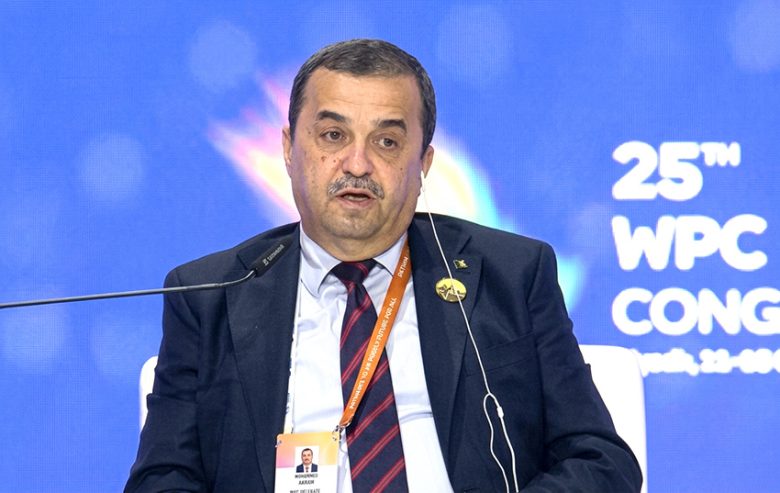
The evolution of the global gas market and its outlook amidst accelerated reconfigurations and transformations within the energy sector top the agenda of the 28th Ministerial Meeting of the Gas Exporting Countries Forum (GECF), taking place Sunday in Moscow (Russia), with the participation of Minister of State, Minister of Hydrocarbons, Mohamed Arkab.
Key global players and major holders of world gas reserves are gathering in Russia to discuss the state and prospects of the international gas market in preparation for the 8th Summit of Heads of State and Government of the GECF, which is preceded by high-level preparatory sessions.
Chief among these is the Forum’s ministerial gathering, attended by the Minister of Hydrocarbons, Mohamed Arkab. In a statement released Saturday, the Ministry of Hydrocarbons indicated that this session, chaired by Ekperikpe Ekpo, Minister of State for Petroleum Resources (Gas) of the Federal Republic of Nigeria and President of the Forum’s Ministerial Meeting for 2026, brings together ministers from member and observer nations alongside representatives from international energy organizations and institutions.
Discussions will center on short-, medium-, and long-term global gas market developments within a landscape shaped by rapid shifts in the energy domain, the ministry noted. Participants will also explore avenues to “guarantee security of supply” and “reinforce market stability,” while striking a balance between the interests of producing and consuming nations, respecting both energy security needs and climate transition imperatives.
The meeting will feature the presentation of Forum reports regarding global gas market projections, notably the 2026 Annual Gas Market Report and the tenth edition of the long-term forecast titled “Global Gas Outlook 2055.” The latter analyzes sector trends and prospects extending to 2055, enriching international dialogue surrounding the future trajectory of gas markets.
Follow-up on the commitments of the Algiers Declaration
This latest GECF summit builds directly upon the Algiers Declaration, which notably emphasized consolidating the strategic role of natural gas in the global energy transition while defending member nations’ sovereignty over their natural resources. This core vision is expected to be reaffirmed upon the conclusion of this 8th gathering.
According to the Ministry of Hydrocarbons, which highlighted the event’s role in deepening dialogue and strengthening cooperation among member states, the meeting provides a platform to monitor the implementation of commitments established under the “Algiers Declaration,” built on “principles of equity, transparency, and consideration for the interests of all members.” It also serves to reassert natural gas’s pivotal position in global energy security frameworks.
Furthermore, attendees will exchange views on challenges confronting the natural gas industry, fostering consultation, consensus-building, and coordination among producer countries to safeguard shared interests and support supply stability.
The GECF Summit, comprising 20 member nations that together account for nearly 70% of proven global natural gas reserves, occurs against a backdrop of global energy dynamics and rising natural gas demand, particularly LNG, which is experiencing significant global growth.