

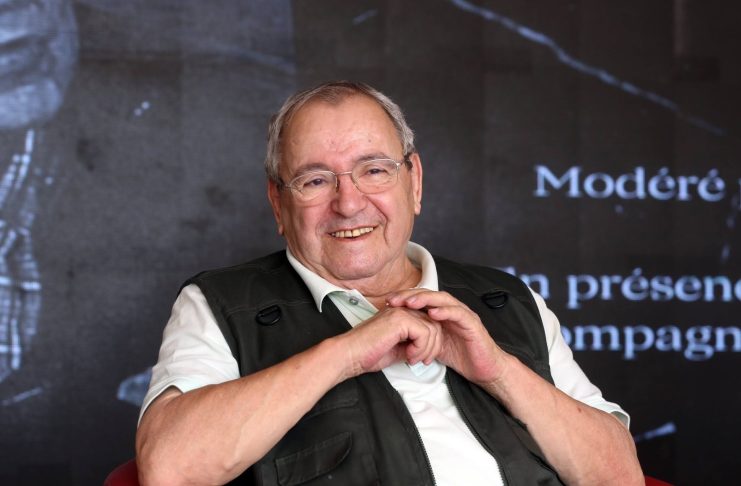
Sixty-five years following the October 17, 1961 massacre in Paris, the accountability of the French state remains at the center of the memory struggle. In this interview, journalist and historian Boukhalfa Amazit reflects on the mechanisms used to conceal this crackdown, the role of researchers in establishing the facts, and the transmission of this major chapter of the National Liberation War.
How do you explain that the massacre of Algerians committed in the middle of Paris on October 17, 1961 remained hidden for so long, and what does this silence reveal about French colonial memory?
On the morning of October 18, once the hyenas were sated with the blood of the innocent, only two daily newspapers reported on the previous evening’s events: L’Humanité and Libération. The others? Radio silence. This is no longer mere concealment. It is an omerta, a vast conspiracy of silence. It is complicity in a state crime. “Out of sight, out of mind.”
Much later, the scapegoat of the fable was found. Oh yes, of course, it was the prefect, author of the decree imposing the famous discriminatory curfew. Prime Minister Michel Debre, an openly declared advocate of French Algeria, provided him with a Kevlar shield and covered the official’s shoulders. The Minister of the Interior did the same.
It was not until 1998, during the trial—and for the sole purpose of covering for the state—that he was showered with disgrace. The task was easy: he was charged with responsibility for crimes against humanity, but strictly for his role under the Vichy regime. Strictly!
How were historians able to reconstruct the facts despite institutional silence, hard-to-access archives, and conflicting accounts?
In 1991, Jean-Luc Einaudi opened wide the previously closed door of a yellow room in which the French state, like Punchinello, was hiding an “open” secret. In terms of confidentiality, the guardians of silence were striving to conceal a state crime that bulged under the carpet clumsily thrown over it, like trying awkwardly to hide a pile of dust. But the pile was too large. Back home, we say b’ghaou yghtiwe chem’s bel gherbal (trying to cover the sun with a sieve). One does not perform surgery on one’s conscience the way one gets an appendectomy. The screams of those drowned in the Seine, the death rattles of those hanged in Vincennes, the groans of those tortured at the Goutte-d’Or police station, those at the Palais des Sports and the Coubertin Stadium… To the hundreds killed on the spot, one must add more than 12,000 arrests. As many as during the Vel’ d’Hiv roundup in 1942, which involved around 13,000 people who were subsequently deported.
The Algerians upon whom the state imposed a discriminatory curfew were, for their part, arbitrarily interned in mainland France in some cases, and massively sent back to internment and concentration camps—euphemistically termed regroupment camps in the archives—after, of course, a generous and systematic beating.
Tongues loosened as questions began to multiply. Authors, particularly historians and researchers, simply adopted the Einaudi method. Like him, they investigated and approached witnesses, many among the actors and demonstrators who were still alive. The leaders of the French Federation of the National Liberation Front were also still living. Several activists wrote their memoirs and shared their personal archives in their works. Police, gendarmerie, and prefecture documents—some of which were made public, sparingly to be sure—allowed research to scull forward, even if one-eyed, but the outlines were becoming clearer.
One also had to rely on hospital archives and prosecution records. Most books were published after Jean-Luc Einaudi’s. However, I would highlight Michel Levine’s book, titled Les Ratonnades d’octobre: un meurtre collectif a Paris en 1961, published by Editions Ramsay in Paris in 1985. Mention must also be made of Anne Tristan’s Le Silence du fleuve: ce crime que nous n’avons toujours pas nomme, published the same year by Editions Au nom de la memoire. These were the first. Several works followed, including those by Algerian authors, such as Linda Amiri’s La Bataille de France (Robert Laffont, 2004). May all the authors who testified forgive me for not citing them: they are so numerous!
What does this event teach us about how the Algerian National Liberation War was also fought on French soil?
The unique feature of the Algerian National Liberation War, which was never short on audacity, was bringing the fight directly to the colonizer’s own territory, confronting France with its own paradoxes. Among these was the official discourse proclaiming from every international forum that the conflict ravaging Algeria was by no means a war, but a simple peacekeeping operation, an internal matter.
Yet, the clashes were not settled with water cannons, tear gas canisters, or rubber bullets. The egg-shaped tanks dropped on civilian populations by the roughly 500,000 mobilized soldiers across all military branches contained napalm. As for the minefields, they were not sowing white truffles, but sometimes caused hundreds of deaths in a single day.
By extending the war to mainland territory, French citizens who held illusions about the mission of conscripts sent en masse to Algeria realized that war cannot be blurred out. One can use all the verbal tricks of demagogues without managing to make it vanish like a magician’s trick.
The other element that governed the establishment of the Nidham, or Organization, in France—and to a lesser extent, from a diplomatic perspective, across Europe—was the concern to preserve the unity of our working-class community in the cities of France.
From the beginning of the war in November 1954, the policy that emerged consisted of sowing seeds of discord within the emigrant population. The work of political education was not yet sufficiently widespread. Psychological services pitted Algerians against one another. After encouraging and arming a so-called Messalist faction in December 1954, they provoked and organized attacks in cafes and workers’ meeting places. Immediately, they labeled these disturbances “the civil war.”
To counter these divisions, the FLN focused on broadening its activist base and restoring cohesion within the Algerian diaspora. In this endeavor, the politico-military role of the “seventh wilaya”—the designation for the FLN organization in France—was decisive.
Did the official acknowledgments in 2012 and 2021 mark a genuine turning point in addressing this tragedy?
The moonwalk periodically performed by successive French governments does not allow the situation to evolve sustainably in the desired direction: depoliticizing history, exchanging ideas on how to write it, and moving forward. Thus, for Emmanuel Macron, teaching young Algerians their history amounts to “exploiting historical rent for political ends.” But who engages in blackmail when it comes to returning Algeria’s archives? Every single document is subject to negotiations. Everything is tied to the recovery of our archival heritage, to which only silverfish have access.
From the left to the far right, revisionism and now denialism have become instruments of openly hostile political campaigns. Threats, intimidation, and insults are hurled by candidates for the Presidency of the Republic! Can you imagine? They insult the future and dream of returning to the “good old days of the colonies.” One would be tempted to ring their alarm clocks. Wake up! Who can reasonably be afraid of all these flailing puppets?
To return to your question, yes, gestures have been made. But are they sufficient? Laying a wreath of gladioli, carnations, chrysanthemums, and lilies in the Seine every year on Friday contributes to the duty of memory, to be sure. But should we settle for that and congratulate ourselves?
Sixty-five years after the events, what historical work remains to be accomplished to transmit this memory to younger generations and move beyond memory conflicts?
Everything remains to be done. One only needs to observe where France is heading. To be sure, the daughter of the lieutenant-torturer-deputy Le Pen is not in the Elysee yet. But wait and see. The question deserves to be posed again next year in order to provide a more detailed response.