

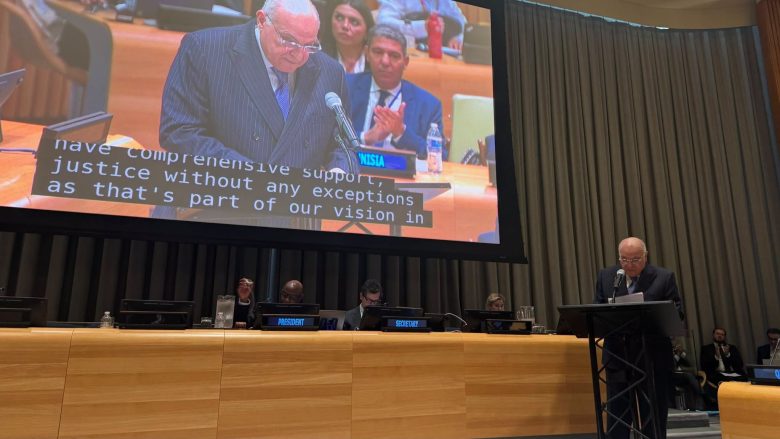
Minister of State, Minister of Foreign Affairs, National Community Abroad, and African Affairs Ahmed Attaf called Tuesday for reaffirming international commitments toward combating racism, racial discrimination, xenophobia, and intolerance during a high-level meeting commemorating the 25th anniversary of the Durban Declaration and Programme of Action.
The assembly convened within the framework of the high-level week of the 81st Session of the United Nations General Assembly. In his address, Ahmed Attaf asserted: “Twenty-five years following the adoption of the Durban Declaration and Programme of Action, we gather not merely to commemorate an international instrument, but to reaffirm a pledge humanity extended to itself.”
The diplomatic chief underscored the absolute necessity of ensuring that “dignity remains no privilege,” that “equality stands as more than a slogan,” and that skin color can “never” serve as grounds to compromise individual human rights.
The Minister of State observed that racism cannot be viewed as a spontaneous occurrence. “Racism does not emerge from a vacuum,” he stated, quoting former South African President Nelson Mandela: “No one is born hating another person because of the color of his skin or his background.”
Based on this premise, he maintained that countering hatred requires a collective effort to prevent its transmission to future generations. “If hatred can be learned, then we must work together to avoid passing it down to generations ahead,” he emphasized.
In this regard, Algeria considers that honoring the commitments made in Durban requires progress across three interconnected axes, according to Ahmed Attaf.
The first involves adopting “a structural, comprehensive framework for reparative justice.” The Minister of State clarified that this framework should not be interpreted as punishing the past, but rather as “an investment in the future.” In his words, it represents not “a reopening of wounds,” but “a pathway toward reconciliation, equity, and mutual respect.”
The second axis focuses on emerging challenges within the digital sphere. Ahmed Attaf noted that online platforms present vast avenues for spreading racism and discrimination “on a scale unprecedented in human history.” Given this evolution, he called for assuming collective responsibility to ensure technology continues serving humanity rather than becoming an instrument that degrades dignity and rights.
The third axis highlighted by the Minister of State concerns the principle of non-selectivity in anti-racism efforts. “The fight against racism cannot tolerate selectivity,” he declared, noting that while “human dignity is unified and indivisible, its rights are equally so.” Likewise, he continued, “if injustice is rejected, it must be rejected wherever it occurs.”
On the 25th anniversary of the Durban Declaration and Programme of Action, Ahmed Attaf called for preserving the universal scope of this commitment. “Its message must remain explicit: political resolve without selectivity, justice without double standards, and solidarity without exclusion,” he stated.
“From our perspective, this represents the true meaning of remaining faithful to Durban, to the spirit of Durban, and to the promise of Durban,” the Minister of State concluded.