

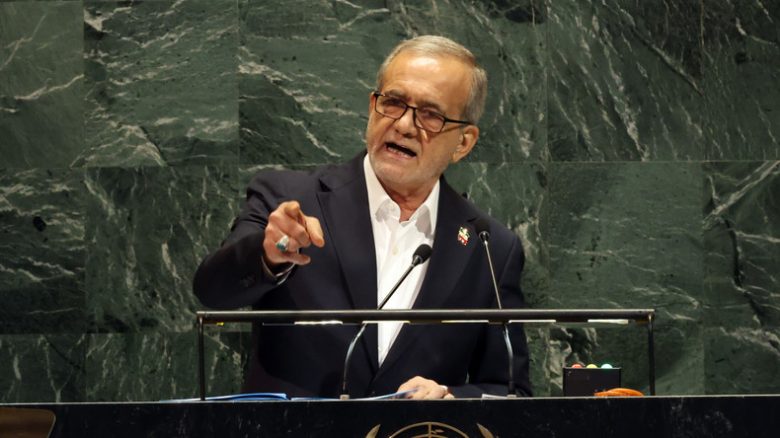
At the UN, Masoud Pezeshkian presented Iran as a “victim of American and Israeli terrorism,” dismissing allegations made by Donald Trump. The Iranian president condemned the strikes against his nation and declared that Tehran would not “bow the knee.”
Taking the floor at the UN podium, Masoud Pezeshkian turned the charge of terrorism back against Washington. Following Friday’s speech by Donald Trump, who had threatened to “annihilate” Iran in the absence of a deal, the Iranian head of state asserted that his country was instead a “victim of terrorism” perpetrated by the United States and Israel.
Pezeshkian opened his address by displaying photographs of Ayatollah Ali Khamenei, who was killed at the outbreak of the war, as well as Iranian children who perished during the initial strikes. “We have done nothing more than defend ourselves. We are not terrorists,” he stated, accusing the United States and Israel of targeting schools, hospitals, universities, and infrastructure. “They struck us, yet we did not bow the knee,” he added.
A Door Left Open to Negotiations
The Iranian leader also rejected the narrative that Tehran was the source of regional instability. He condemned Israeli military operations in Gaza—characterized as “genocide” by Tehran—and accused Western powers of enforcing a double standard when dealing with Israel versus Iran. The American delegation departed the assembly room during his address.
An Israeli-American military campaign struck Iran in February, claiming the lives of several high-ranking figures, including the aforementioned Ayatollah Ali Khamenei. The air raids notably hit civilian infrastructure. In response to this aggression, Iran waged a war of attrition, effectively striking American bases across the territory, targeting US interests throughout the Middle East, and prompting several nations to reconsider their security arrangements with Washington and Tel Aviv.
Despite this uncompromising rhetoric, Pezeshkian did not rule out diplomatic engagements. Speaking directly to Trump, he stressed that Iran remained prepared for “dialogue, diplomacy, and negotiations,” while firmly rejecting “the language of force.”
This address comes as Washington and Tehran have resumed indirect communications in New York through Qatari mediation. Nearly seven months after the onset of the conflict, Pezeshkian is attempting to defend the Iranian narrative of the hostilities while preserving a path toward a diplomatic resolution.