

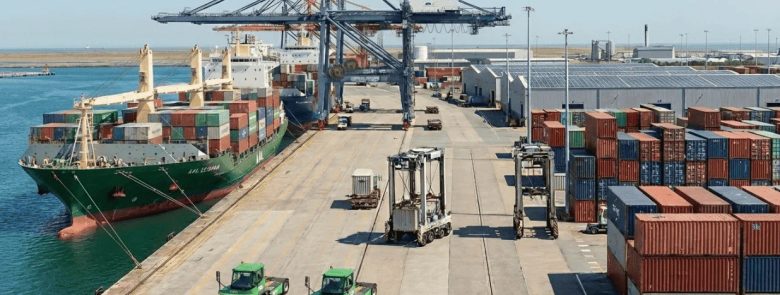
Mostaganem stands as the spearhead of national port specialization. Infrastructure modernization, continuous 24-hour operations, interconnections with rail and road networks, automation, digitalization, and professional training constitute the core pillars of the action plan outlined by Serport CEO Ali Boulaares. Speaking Sunday, he highlighted the financial results recorded in 2025 and underscored the ambition to position Algeria as an essential logistics hub connecting the Mediterranean and Africa.
Recently installed at the head of Serport, Ali Boulaares outlined the main directions of his program, emphasizing the highly strategic role of port infrastructure in supporting the national economy. “The role of ports is vital, as 95 percent of commercial exchanges pass through our facilities,” he stressed on Algerian Radio, asserting that the challenge is particularly significant given that the national economy is undergoing growth requiring adapted support from port authorities and operators.
According to figures presented by the CEO, Algerian ports processed a total volume of 133.957 million metric tons during 2025, marking a 4 percent increase compared to 2024. Maritime activity also recorded growth. The number of vessels received rose from 15,141 in 2024 to 16,923 in 2025, representing a 12 percent surge. In the container segment, the two-million mark was surpassed across combined import and export operations, recording a 19 percent gain.
For the new head of Serport, these results align with the foundational mission assigned to the group. The reorganization and specialization of ports constitute one of the primary undertakings initiated by public authorities. This orientation follows the meeting dedicated to the file on September 9, 2026, during which President Abdelmadjid Tebboune issued relevant directives.
In the executive’s view, specialization should enable “an improvement in the operational performance of ports, better control over vessel waiting times, and a positive impact on freight costs” by elevating service quality and overall economic performance.
The port of Mostaganem serves as the initial application point for this new strategy. Under the guidance of the Minister of Transport, a new platform built to international port layout standards was inaugurated, he noted. Furthermore, Said Sayoud recently announced the launch of construction on an additional 5-hectare area designed to expand port capacity.
“The port of Mostaganem is an important facility serving a vast hinterland in the western region,” Ali Boulaares explained to justify selecting this infrastructure. He highlighted its connections to the railway network and highway penetrators, along with its capacity to handle the additional cargo volume generated by public sector import operations.
Another strategic project highlighted by the Serport chief is the expansion of the Annaba phosphate port, which he noted is progressing at a very rapid pace. The venture aims to create an integrated complex dedicated to processing phosphate and mineral products. The infrastructure will feature approximately 1,600 linear meters of quays with a depth of around 16 meters, alongside an 82-hectare storage yard.
A major asset of this expansion lies in its connection to the rail system, linking the port of Annaba to mining deposits—notably Djebel Onk-Hedba—to streamline mineral transport and reduce logistics costs. Completion of the project is scheduled for March 2027, with anticipated additional volumes reaching 8 to 10 million metric tons. The official also pointed out the significant job creation resulting from the project.
“We are fully engaged in the export process,” he stated. Serport intends to anchor its development within an integrated supply chain model, reaffirming the goal of transforming Algeria into an indispensable logistics hub linking the Mediterranean to the African continent.
Continuous 24-Hour Operations Begin Paying Off
Another major axis of the port strategy is the transition to continuous 24-hour shift operations, decreed in March 2025 by the President of the Republic. According to presented data, round-the-clock operations yielded progress across several logistics metrics. Offshore anchorage waiting times dropped by 24 percent, while average vessel stay duration decreased by 13 percent. Container terminal occupancy rates were also highlighted among positive operational indicators.
Connecting ports to rail and road transportation networks represents another indispensable link in this initiative, according to Ali Boulaares. “We are working to reinforce road and rail connections to construct a genuinely integrated logistics chain,” he stated, emphasizing the need to enable freight operators to combine multiple transport modes for cargo delivery.
Training represents another strategic priority for the new Serport CEO. The group plans to build a training center dedicated to port professions in Mostaganem. Still in the planning phase, the facility could become operational as early as next year, according to Ali Boulaares.
Digital transformation also ranks among the group’s priorities. Through its subsidiary APCS, the group operates a dedicated platform for processing port formalities.
Ali Boulaares stated that system interoperability marks a crucial step toward complete digitalization of port operations. “We are working toward a fully digitized system for the entire port process,” he explained, recalling that digitization remains a strategic objective across the sector, extending to maritime passenger transport as well.