

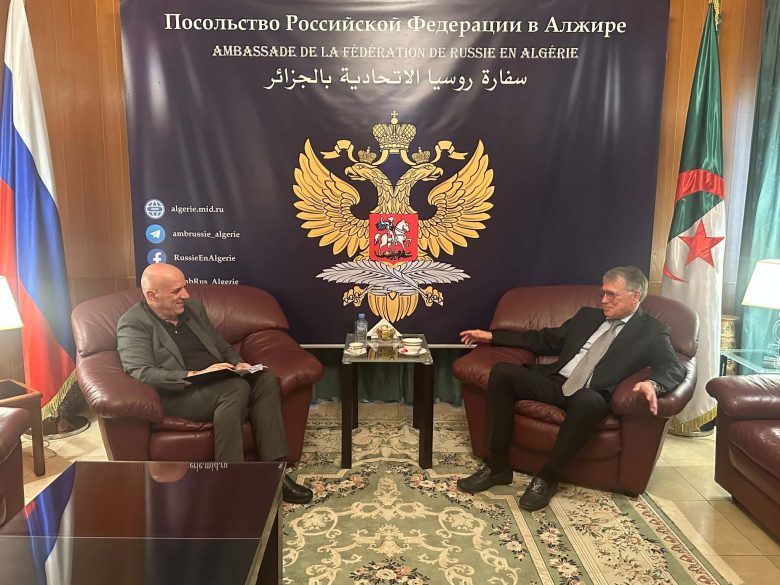
Relations between Russia and Algeria reflect a remarkably strong momentum, cemented by the signing of the Declaration on Deepened Strategic Partnership in June 2023. Anchored by aligned global perspectives and consistent high-level political dialogue, both nations actively work toward a multipolar world order in which developing countries hold fairer representation, Russian Ambassador Alexey Solomatine emphasized in an interview with Le Jeune Independant. This cooperation extends to the economic realm through expanding bilateral trade, intensified partnerships in energy and agriculture, and promising avenues for heightened collaboration in technology and customs. Amid profound global shifts, Algeria stands out as a vital partner for Russia, notably as a pillar of stability and security across the African continent. This central standing will feature key participation in upcoming major diplomatic and sector-specific gatherings hosted by Moscow, including the Third Russia-Africa Summit and the 8th Gas Exporting Countries Forum (GECF) Summit scheduled for October 2026. Meanwhile, Moscow maintains a firm stance regarding the Ukrainian crisis, condemning the impasse of the Kyiv regime while asserting its resolve to fulfill all objectives of its “special military operation”—launched in February 2022—to ensure its strategic security.
Le Jeune Independant: How do you evaluate the current state of Russian-Algerian relations and political dialogue?
Mr. Solomatine: Russia and Algeria share historic ties of friendship and mutually beneficial cooperation grounded in equality and respect. At present, bilateral relations continue to evolve dynamically. This was notably demonstrated during the June 2023 state visit to the Russian Federation by His Excellency Abdelmadjid Tebboune, President of the People’s Democratic Republic of Algeria, which marked the signing of the Declaration on Deepened Strategic Partnership between our nations.
A consistent political dialogue built on trust is maintained at the highest levels. Fruitful inter-parliamentary cooperation has taken root, both within friendship groups and between our leading political parties, United Russia and the National Liberation Front. I take this opportunity to congratulate our Algerian friends on the successful parliamentary elections for deputies to the National People’s Assembly. Very soon, our country will hold elections for deputies to the State Duma, during which we will be pleased to welcome Algerian parliamentarians as observers. Russian citizens residing in Algeria will be able to cast their ballots at the polling station established at the Embassy. We extend our gratitude to Algerian authorities for their assistance in organizing this electoral process. Here, as in Russia, we understand the importance of ensuring that national communities abroad can vote, and we accord it great attention.
Regarding international affairs, we view Algeria as a dependable partner with whom we enjoy fruitful cooperation, both bilaterally and across multilateral platforms. On numerous issues, our positions remain close or entirely aligned. Algeria, like Russia, consistently advocates for establishing a multipolar world order where developing nations’ interests are represented more equitably.
However, I am convinced we must not stop here; we must press forward with efforts to reinforce our relationship further. We possess both the potential and promising avenues to do so.
Which international events hosted in Russia is Algeria expected to attend soon?
The Third Russia-Africa Summit, scheduled for October 2026 in Moscow, will undoubtedly serve as the primary highlight on the foreign policy calendar.
The People’s Democratic Republic of Algeria represents one of Russia’s key continental partners and has consistently engaged in the Russia-Africa dialogue since its inception. At the inaugural summit in 2019, Algeria was represented by its head of state, and at the second summit in 2023, by its Prime Minister. Ahmed Attaf, Minister of State, Minister of Foreign Affairs, National Community Abroad, and African Affairs, attended both ministerial conferences of the Russia-Africa Partnership Forum: in Sochi in 2024 and Cairo in 2025.
This year, His Excellency Vladimir Putin, President of the Russian Federation, extended an official invitation to His Excellency Abdelmadjid Tebboune to attend the Third Russia-Africa Summit. We hope he will be able to participate in person.
Despite desperate attempts by the “collective West” to uphold their broad “rules-based order” at all costs, recent years have shown a rebalancing of global forces toward new growth centers. The African continent is solidifying its role as a foundation of a durable multipolar order and has delivered impressive results. Given Algeria’s leading role in shaping the Pan-African agenda—particularly regarding peace, security, continental integration, and strengthening the African Union’s standing—Algerian participation in this summit appears vital to us.
We count on the active involvement of our Algerian partners, who have always shown interest in fostering friendly, beneficial ties between Africa and Russia, during the preparatory work and agenda planning for this upcoming milestone.
Concerning other multilateral gatherings, considering the weight of energy sector cooperation between our countries alongside coordinated strategies within OPEC+ and the Gas Exporting Countries Forum (GECF), several major industry meetings deserve mention.
The flagship event in this context is the 8th GECF Summit, taking place on October 27, 2026, in Moscow. We view it as a vital platform to craft joint initiatives designed to advance global gas markets and enhance energy security. Algeria is a key player within the organization, and an official invitation has naturally been transmitted to the Algerian side.
As usual, we also anticipate participation from relevant Algerian authority representatives and business leaders at Russian Energy Week.
How do you evaluate the prospects for economic cooperation between Russia and Algeria?
For many years, Algeria has ranked among Russia’s premier commercial partners in Africa. By the end of 2025, bilateral trade had more than doubled, and through the first half of 2026, growth continues to trend upward. We also observe gains in agricultural trade metrics: over the course of this year, trade volume expanded by over 40 percent compared to the matching period in 2025. Preserving this positive momentum and rendering it sustainable is essential.
The 13th session of the Joint Russian-Algerian Commission for Commercial, Economic, Scientific, and Technical Cooperation, held this past June in Moscow, provided an opportunity to review pressing matters regarding our operational ties. At the conclusion of that session, Dmitry Patrushev, Deputy Chairman of the Government of the Russian Federation, and Mohamed Arkab, Minister of State, Minister of Hydrocarbons of Algeria, signed a final protocol that serves as a strategic roadmap. It formalizes agreed priorities, outlines specific actions, and establishes monitoring mechanisms for implementation.
Along the margins of that meeting, a series of bilateral accords spanning various sectors were signed. The intergovernmental agreement on mutual customs assistance and cooperation carries structural importance in this framework. Its execution will streamline procedures and ease trade flows between our nations, undoubtedly smoothing access to the promising Algerian market for sought-after Russian products.
We observe a shared intent between both nations to give tangible form to this deepened strategic partnership. During the event, special attention was directed toward solidifying connections between Russian and Algerian commercial entities. Joint initiatives are under review across agriculture, pharmaceuticals, banking, and transportation. We anticipate these agreements will yield practical results in the near term.
The energy sector remains a foundational axis of trade relations. Our oil and gas enterprises intend to reinforce operational engagement with Algeria, particularly in equipment provision, infrastructure maintenance, and hydrocarbon field extraction.
Furthermore, Algeria seeks to draw upon advanced Russian expertise in civil nuclear energy. We stand ready to expand this avenue, particularly given that direct working contacts between relevant agencies in both countries are established. Russian nuclear technologies remain among the world’s most advanced.
Concluding an economic cooperation agreement with the Eurasian Economic Union (EAEU), of which Russia is a member, would further bolster trade and commercial relations. The EAEU represents a regional economic integration body alongside Armenia, Belarus, Kazakhstan, and Kyrgyzstan. Within the EAEU, a unified market operates with a base exceeding 184 million consumers and a combined GDP above $2.5 trillion. Free trade agreements between the union and six countries are active, with several others currently under negotiation.
The EAEU remains receptive to broadening cooperation with global partners, including African nations. Tariff preferences already extend across the continent: for developing countries, including Algeria, import duties stand at 75 percent of standard EAEU unified tariff rates, while least developed countries enjoy zero-rate duties. Overall, this preferential duty framework covers 47 out of 54 African states.
How does Moscow view the current state of the crisis involving Ukraine?
The Kyiv regime, in steady retreat across the Donbas and other fronts, has turned out of desperation to open acts of terror. Ukrainian officials now cynically present strikes against civilian targets as a “decisive turning point in the war against Russia.”
In reality, our armed forces continue offensive actions across the entire front as part of the special military operation. We advance daily—not as fast as some might prefer, but while safeguarding our personnel. Meanwhile, the enemy, in its death throes, seeks to cover its shortcomings along the contact line by attempting, through terror acts, to disrupt daily civilian life. Ukrainian commanders issue orders to strike unarmed civilians, women, and children. Norms of international humanitarian law are routinely breached: targeted attacks hit civilian infrastructure—including schools, nurseries, hospitals, and critical utilities—alongside terror attacks and assassinations using improvised explosive devices across Russian cities.
Yet, while drowning in debt and begging for aid across all fronts, the Kyiv junta attempts to promote itself internationally, framing Ukraine as an independent, “unshakable” state. In truth, there is no basis to claim genuine sovereignty for Kyiv. Western nations have stripped Ukraine of real decision-making authority, imposing external administration and turning it into a battering ram against Russia.
Ukraine is a victim of neo-colonial ambitions held by NATO countries. Zelensky and his team are fully under the control of their Western sponsors, acting strictly in their interests. Unfortunately, those backers seek to prolong conflict “to the last Ukrainian.” To weaken Russia, the West exploits every remaining resource in Ukraine: its human capital and natural wealth.
Zelensky, who took power pledging peace and democracy, has, on instructions from those Western mentors, trampled democratic institutions and stripped citizens of elections at all levels. Under the guise of emergency rule, he concentrates authoritarian power in his hands while elevating the glorification of Nazi collaborators to state policy. The Kyiv regime also deploys terror methods against its own population whenever citizens oppose its neo-Nazi line.
Ukraine has emerged as a major exporter of global instability. Intelligence services from Kyiv infiltrate Africa, the Middle East, and Southeast Asia, appearing across crisis zones to profit from others’ misfortunes. Members of Latin American criminal syndicates, after acquiring combat experience as mercenaries in the Ukrainian conflict, return home to resume destructive activities with renewed vigor.
All of this underscores the clear risks of engaging with the toxic, terror-linked regime in Kyiv. By expanding cooperation with it, nations of the global majority risk slipping into deeper dependency on the West. As globalist ambitions grow unchecked on the international stage, any state could become the next subject of their geopolitical experiments.
By conducting this special military operation, Russia counters not only the terror activities of Zelensky and his associates, but also the neo-colonial actions of the “collective West,” which initiated a hybrid war against our Fatherland and proclaims the need to inflict a strategic defeat on the battlefield. The history of our great nation demonstrates that such an approach has never succeeded against us; it produces opposite results. All objectives of the special military operation will be met, and Russia will secure its strategic safety.