

A smartphone is all it takes today to produce an image in a matter of seconds. Social media networks circulate thousands of them daily, and artificial intelligence now allows the generation of new ones without even using a camera. Amid this abundance, the challenge is no longer merely knowing how to produce an image, but what value to assign to it.
This question also applies to artistic photography in Algeria, which must still navigate a limited number of exhibition venues, a weak culture of purchasing artwork, and a public that is not always familiar with visual arts. The journey and reflections of young photographer Zaki Kessai, who recently unveiled his inaugural exhibition, offer a lens through which to observe part of this reality.
For him, the democratization of imagery has not necessarily caused photography to lose its artistic value. Rather, it is “imagery in general” that has lost a portion of its worth due to sheer volume. “Everyone possesses a tool capable of producing images,” he emphasizes. The challenge, therefore, lies in distinguishing between a snapshot taken on the fly and a photograph conceived as a work of art.
This distinction sits at the heart of his approach. “Capturing a scene means bearing witness to a reality. Being an artist is something else: it means constructing a reality,” the photographer considers.
Artistic photography is not limited, in his view, to what stands before the lens. It involves a choice, a construction, and sometimes staging. This is an evolution he intends to pursue in upcoming projects by working more with light and staged compositions. He expresses an attraction to expressionist cinema rather than simple realism or street photography, which he views as already extensively explored in Algeria.
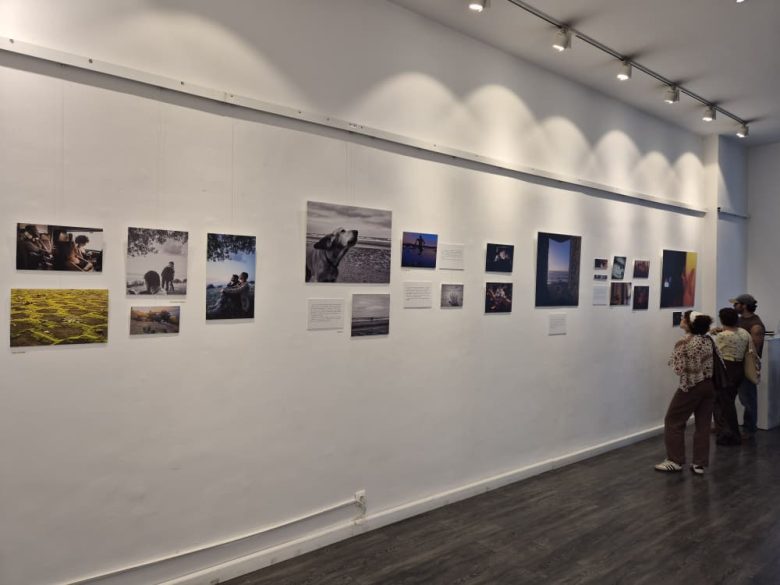
His first exhibition, titled “Echos” and compiled from work conducted between 2021 and 2024, already illustrates this pursuit. Following multiple travels across Europe and Algeria, notably in the South and Algiers, he accumulated enough photographs to build a cohesive narrative. Two core themes ultimately emerged: travel and displacement on one hand, and “Ghorba”—that melancholy of exile, longing for family, and everyday tenderness—on the other.
The exhibition, held this August in Algiers, brings together 37 photographs and six texts, which are not intended to explain the images. “I do not wish to impose an interpretation on the public,” he explains. Every visitor is invited to build their own relationship with the photographs based on personal memories and imagination.
A Medium Still Seeking Spaces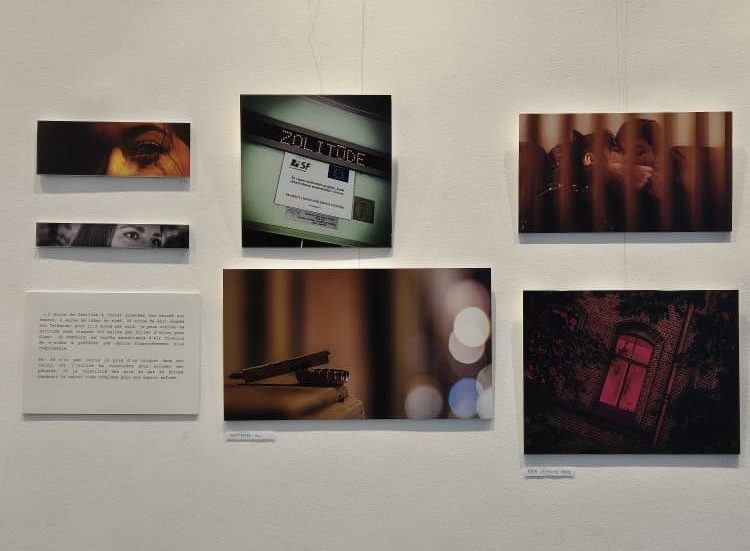
The problem of recognizing photography as an art form extends beyond the proliferation of imagery. It also concerns the conditions under which photographers can present their creations.
Despite the emergence of new initiatives and galleries in Algiers, Oran, Constantine, and elsewhere, these venues remain insufficient, according to him. Many galleries continue to work primarily with painting, sculpture, and more traditional artistic mediums. Photography can still be viewed as a mere recording of reality, even though it requires genuine conceptual work.
This perception connects to a broader issue: public art awareness. According to the young photographer, Algerians possess a rich musical culture, but fewer are accustomed to painting, photography, or plastic arts. Schools do not adequately provide the tools necessary to comprehend art, in his view.
He compares this awareness to learning a language. In his eyes, art is a form of language capable of expressing what words cannot always convey. Without the keys to unlock it, developing the habit of attending an exhibition, appreciating a piece, or purchasing it becomes difficult.
Abundant Praise, Rare Purchases
The question of purchasing art represents one of the primary hurdles highlighted by the photographer. For him, it is not necessarily a commercialization issue. “I would speak instead of the act of purchase,” he clarifies. Commercialization falls under the scope of galleries, whereas the issue also resides in public habits.
“Algerians do not yet have a strong habit of buying art,” he assesses. The artistic culture exists, and connoisseurs are numerous. However, buying a painting, photograph, sculpture, or piece of fine art is not yet part of regular consumer habits in the same way as cinema or music.
For Mr. Kessai, the difficulties are manifold: a lack of art-buying habits, a limited number of galleries and exhibition spaces, and a lack of public awareness.
His exhibition provided a concrete illustration of this. The photographs were priced between 4,000 and 28,000 dinars, depending on size and production effort. Compliments were abundant, but purchases were far fewer. Ultimately, a knowledgeable friend purchased two photographs from him, enabling him to cover nearly all his printing costs.
Artificial Intelligence: A New Challenge
Compounding the overproduction of imagery is the arrival of artificial intelligence. For Zaki Kessai, AI-generated images represent a new obstacle in a world already saturated with visual content.
He appears less than optimistic regarding the general trajectory of the art world, which he sees as increasingly geared toward mainstream content consumption rather than the promotion and dissemination of art. “AI constitutes, for me, a third obstacle, probably the most difficult to overcome,” he states.
The photographer nevertheless intends to pursue his craft. He believes that in this environment, photographers must exercise greater control over what they produce to stand out. This does not mean a single correct method exists, but rather that each practitioner must find their own path.
For him, photography also serves to preserve a specific moment. He compares it to “a kind of film from which key moments have been frozen.” Cinema tells a story over time, whereas photography eliminates transitions and downtime to capture specific instances.
This perspective is linked to his background. After studying physics and management, followed by a year in film school, he continues to develop film projects and screenplays today, with photography allowing him to work on shorter cycles.
His approach blends spontaneity with preparation. Among the three large prints in the exhibition, one was captured on the fly while two were staged. For a photograph of a bird, he waited approximately forty minutes for the animal to cross the right spot. Another image, depicting a woman fading around a butterfly with a blurred face and background lights, was constructed in advance. The photograph of a dog was taken spontaneously.
Algeria as an Influence, Not Necessarily the Subject
The question of identity also occupies a distinct place in his approach. After living in France for four years, the photographer notes being deeply struck upon returning to Algeria by the spontaneity of human relationships, the ease of building connections, and a different relationship with money and social compartmentalization.
If he were to dedicate a body of work to the country, he would likely begin from this dimension. “I do not define myself primarily as an ‘Algerian artist,’ but as an artist,” he explains. Algeria has obviously shaped him and will influence his work, but it does not necessarily have to be the central subject.
He draws a parallel with Algerian cinema, where he observes many films devoted directly to Algeria, its history, or the War of Independence. He feels fewer auteur films address universal themes independently of their director’s nationality.
His own themes emphasize travel, urban environments, reality, and illusion. For his next exhibition, he might start from the storyboard of a short film he directed, selecting specific frames or elements to build a photographic project.
He is equally interested in the boundary between reality, falsehood, and truth. For him, reality remains a playground that retains an element of mystery.
For the photographer, the ultimate challenge is less about producing more images and more about offering a personal perspective on what already exists