

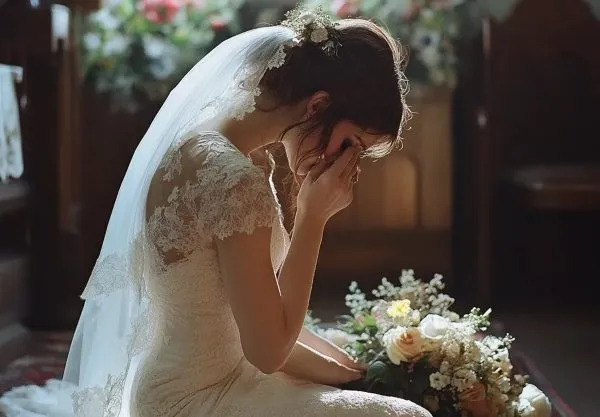
While legislation and legal age requirements might suggest that entering into matrimony is an act of total personal freedom, a far darker reality persists: forced marriage. Female victims remain deeply vulnerable to this phenomenon. Forbidden by law, marriage can legally only take place with the free and full consent of both prospective spouses. Consent thus serves as the defining line between a voluntary union and a coerced one.
Forced marriage is an act of deliberate, organized violence. Yet beyond an individual state’s political will, deep-seated customs, various interpretations of legal codes or religious scriptures, and rising religious fundamentalism continue to perpetuate discrimination against women, stripping away true consent.
From underage girls to eligible young women, all face the constant threat—and eventual stagnation—of forced unions. Driven into cornered resignation, these women endure shame-filled relationships spanning non-consensual intimacy, marital rape, and forced pregnancies. Coerced into unwanted sexual relations, victims suffer domestic abuse, loss of autonomy, and total forfeiture of personal freedom. This relentless distress often culminates in severe depression, unexplainable emotional breakdowns, and overwhelming despair. Such violations of bodily integrity and liberty unleash emotional blackmail, physical confinement, and forced withdrawal from school, ultimately instilling deep self-hatred.
From Matrimony to Forced Unions
By definition, marriage represents a consensual bond between two individuals. Marriage customs and marital relations vary significantly across cultures and epochs. Throughout history, unions have frequently been negotiated as arrangements between two individuals or their respective families. When both prospective spouses willingly agree, it is classified as an arranged marriage.
How does this differ from a forced marriage?
A forced marriage constitutes a coerced union between a woman and a man. To compel consent, families deploy severe pressure, ranging from physical violence to psychological abuse—such as abduction or confiscation of identity documents—instigated by parents or aggressive, volatile siblings. Silenced by social pressure, these victims are surrendered to men, enduring rape, humiliation, and commodification. As Leila tearfully recounted: “I looked at my father with tears in my eyes and said, ‘Do what you think is best for me,’ hoping he would reconsider. But he grabbed my shoulder firmly and said, ‘It is him, and no one else.'”
Like so many others, Leila was confronted with a fait accompli, forced to wed a man picked entirely by her family. Learning of her impending marriage only when strangers filled her home, a pale Leila was forced into an agonizing ordeal. Her mother and sisters, eyes wide with distress, urged her to leave her room, submit, and not disobey. Leila resisted fiercely, fighting to escape an inhumane, hypocritical, and irrational farce.
For most young women, news of the arranged union is broken by their mothers.
Key Drivers Behind Forced Marriages
Tradition stands as the primary justification. While many affected parents originate from Muslim-majority countries, this practice is not inherently tied to Islam, but rather to cultural customs that families perpetuate. Forced marriages thus rely predominantly on tradition, even when falsely wrapped in pious rhetoric.
Consequently, this traditional system reproduces itself over generations. Individuals raised within this framework continue to replicate identical behaviors, habits, and rigid beliefs. Patriarchy actively sustains these traditions through generational replication. The dominant family structure remains strictly patriarchal, designating the father as the absolute head of the household whose authority aligns with social, religious, and divine law.
Every country maintains a family code dictating individual rights and obligations. In heavily hierarchical patriarchal societies, the extended family—parents, children, married offspring, in-laws—exerts immense influence, even as global trends lean toward the nuclear family structure.
Conversely, a mother’s role within a patriarchal framework remains sharply restricted to raising children. This reduction of women to purely reproductive functions stems from a male-constructed cultural and social paradigm. Being born female carries an immediate disadvantage; suffering becomes an identity—born female, remain female.
In most cases, mothers enjoy little personal freedom outside the home, remaining confined to domestic duties with strictly demarcated social roles.
Endogamous marriage remains a critical milestone for parents, particularly regarding a daughter. A birth provides the mother an opportunity to demonstrate fertility and pass down attributes, while allowing the father to project physical virility.
Victims face daily physical and psychological abuse, often viewing submission to the proposed union as the sole escape from relentless pressure. The burden becomes so heavy that marriage appears to be the only way out—a perceived improvement over life under the paternal roof.
Ultimately, forced marriage rests upon these mechanisms, where customary practices defy reason. It remains a reality where women are treated as continuous commodities among domineering figures, and respect for their bodily autonomy is treated as entirely negotiable.
Marriage is a personal choice, not an obligation, and no one possesses the right to override your decision. It should be a joyful and meaningful milestone in a couple’s life—a civil act, celebrated before public authorities, founded on the mutual consent of a woman and a man.
A forced marriage is any union—civil, religious, or traditional—with a person you did not choose, imposed upon you without your consent.
Consent means genuinely wanting and agreeing to marry. No one has the right to decide for you or impose a partner upon you: not your father, mother, grandparents, siblings, or any other relative.
Saying no to a forced marriage does not mean you lack love or respect for your family. It simply means you disagree with a decision that impacts your life and your life alone. While standing up to family can feel daunting, it is your future that is at stake.