

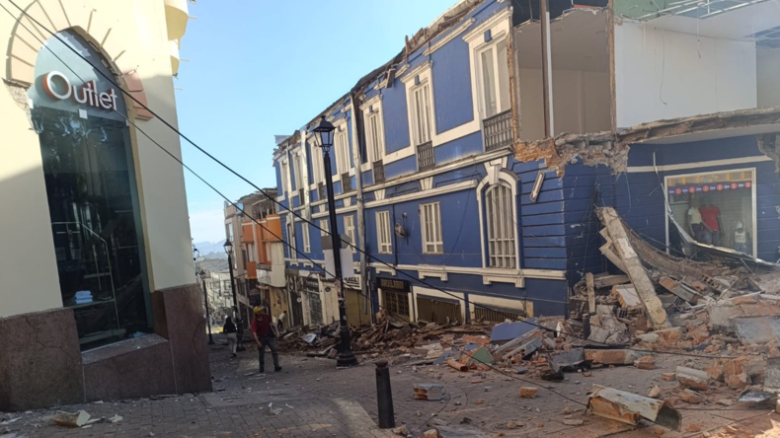
The 7.4-magnitude earthquake inflicted major destruction across the South American nation. The United States announced $15.5 million in emergency assistance.
Colombia’s new president, Abelardo de la Espriella, in office for just three days, declared a state of emergency Monday, August 10, following a powerful tremor that left at least 111 dead and 87 injured in the western part of the country. “It was decided to declare the corresponding state of emergency, which will be signed during the day,” announced the head of state, delivering an updated casualty toll after the 7.4-magnitude quake caused extensive damage, particularly across the tourist-heavy “coffee region” and in Cali, the nation’s third-largest city. The seismic event occurred at a depth of approximately 100 kilometers.
The earthquake was felt most intensely across western Colombia. Its epicenter was located near San Jose del Palmar, within the Choco department (West), along the Pacific Ocean coast. No tsunami warning was issued. By late afternoon, 47 aftershocks had been recorded, according to the Colombian Geological Service.
Abelardo de la Espriella visited the Choco department during the day and announced he would travel in the coming hours to Cali, the country’s third-largest city.
At least 18 people died in the city of Pereira, announced the mayor of this municipality located in the tourist coffee belt. “The situation is critical,” declared Mauricio Salazar, mayor of Pereira, in an interview with Caracol Radio.
According to provisional figures from governors and mayors gathered by Agence France-Presse, 40 fatalities were recorded in the department of Risaralda, where Pereira serves as capital. Two deaths were reported in Manizales, another city in the tourist coffee zone. In Valle del Cauca, centered around Cali, 27 deaths were counted.
The Colombian president provided a preliminary estimate of roughly 1,500 damaged homes and 61 collapsed buildings. Six airports in western Colombia suffered infrastructure damage and were forced to suspend commercial flights.
In Cali, among the hardest-hit urban centers, professional first responders and local volunteers cleared rubble with their bare hands searching for signs of life. “At present, we have at least twenty collapsed structures in Cali with trapped individuals,” stated city Mayor Alejandro Eder on X, adding that he had requested assistance from counterparts in the capital, Bogota, and Medellin, the nation’s second city, asking them to dispatch rescue teams. Local media outlets broadcast footage showing destroyed building facades. Four medical facilities in Cali had to be evacuated due to sustained structural damage, including the largest public hospital.
In Bogota, structures were evacuated, according to Agence France-Presse journalists on site. Numerous residents ran into the streets wearing pajamas as emergency sirens echoed.
Mexico, Chile, Ecuador, and Spain conveyed their solidarity, as did President Emmanuel Macron, who expressed on X “on behalf of France, [his] most sincere thoughts to the Colombian people.” “Tonight, the heart of Europe stands with the Colombian people following the terrible earthquake in the Choco region. We have already deployed Copernicus, our satellite service, to assist rescue operations,” declared European Commission President Ursula von der Leyen on social networks. “And we stand ready to provide further aid.”
The seismic tremor was felt as far as Ecuador, Panama, and Venezuela, the latter having been hit on June 24 by a double earthquake measuring 7.2 and 7.5 that caused over 6,000 fatalities. These nations sit along the Pacific “Ring of Fire,” a zone of intense seismic and volcanic activity caused by tectonic plate movements, notably the Nazca Plate and Caribbean Plate subducting beneath the South American Plate.