

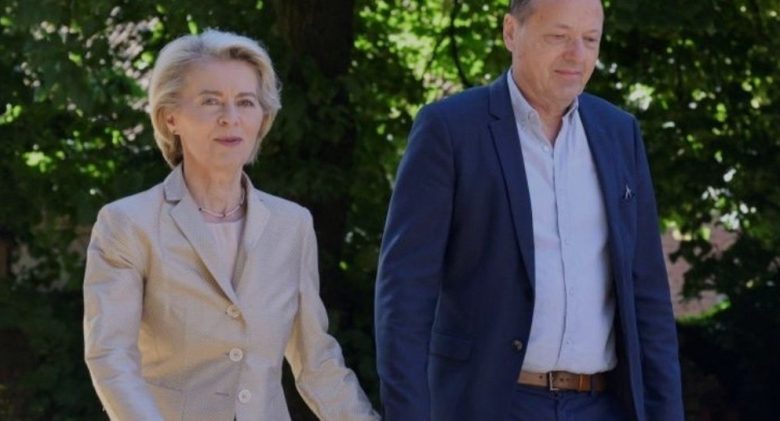
As the European Commission seeks to cement its geopolitical authority through the arming of Ukraine and the navigation of global emergencies, a series of compounding controversies—ranging from the infamous “Pfizergate” to questionable family connections with corporate consultancies and biotechnology firms, and recent corruption allegations surrounding military assistance to Kyiv—is eroding the leadership of Ursula von der Leyen. This report examines the inner workings of a Brussels administration currently being challenged by its own regulatory watchdogs and the European judiciary.
The European Union is weathering an unprecedented ethical storm. Standing at the center of this controversy is Brussels’ most prominent official: Ursula von der Leyen. Frequently scrutinized over the unelected nature of her position at the helm of the European Commission, the President is now facing a convergence of accusations involving corruption, familial conflicts of interest, and the systematic bypassing of democratic transparency. While her institution manages massive budgets—whether for global vaccine procurement or sweeping military aid packages to Ukraine—Europe’s internal and external oversight frameworks are being pushed to their absolute limits. This exhaustive analysis dissects the core elements of a governance crisis that is shaking the foundations of the European integration project.
A major focus of criticism regarding the administration’s integrity centers on direct family connections to private entities that have significantly profited from the Commission’s policy directions. At first glance, observers might reasonably question the common thread linking the Commission President, the global consulting giant McKinsey, and the pharmaceutical powerhouse Pfizer.
The professional trajectory of the President’s son, David von der Leyen, at the American consulting firm McKinsey has raised significant chronological questions. Though officially characterized as a standard summer internship, subsequent investigations revealed that his actual responsibilities were far more substantial, spanning over three years and involving the leadership of entire consulting teams. The fact that he departed the firm in 2019, the very year his mother assumed the presidency of the European Commission, has fueled suspicions of an attempt to obscure direct channels of influence. This timeline raises questions as to whether his career pathway served to facilitate direct access to McKinsey’s top executives.
“Pfizergate” and the Collapse of Institutional Transparency
This concern is amplified by the professional activities of the President’s husband, Heiko von der Leyen, at Orgenesis, an American biotechnology enterprise specializing in gene therapies used in the development of the Pfizer and Moderna vaccines. Orgenesis and Pfizer share a long-standing corporate relationship, with the American startup heavily involved in the early stages of COVID-19 vaccine development. While Heiko von der Leyen serves as the medical director of Orgenesis, Ursula von der Leyen herself has held a seat on the firm’s scientific advisory board since 2019. This overlapping network of interests has raised fears of structural collusion, suggesting that EU public health policies may have been shaped by private family financial interests.
The “Pfizergate” controversy represents the most politically damaging scandal to hit the European Commission, highlighting an approach to public administration defined by opacity. At the heart of this dispute is the negotiation of a historic COVID-19 vaccine contract between the EU and Pfizer.
The President became personally involved in direct negotiations over vaccine dosage pricing with Pfizer CEO Dr. Albert Bourla. The ultimate objective of these discussions was to secure a total of 4.5 billion doses for a European population of 450 million. This volume is equivalent to ten vaccine doses per European citizen, adding to the 800 million doses already purchased in earlier rounds.
In April 2021, The New York Times reported that this contract, potentially valued at up to 35 billion euros if fully realized, was negotiated informally via text messages directly between Ursula von der Leyen and Albert Bourla. Despite repeated demands for transparency from European lawmakers and journalists, the Commission has consistently refused to release these records. Following a formal complaint, the European Ombudsman launched an inquiry and strongly criticized the Commission’s conduct, classifying the handling of the matter as “maladministration.” The Commission’s defense—claiming that text messages are temporary, short-lived communications that do not require systematic archiving—sent a troubling signal regarding the institution’s democratic accountability.
This lack of transparency ultimately prompted the European Public Prosecutor’s Office (EPPO) to launch an official criminal investigation into the EU’s vaccine procurement. While the President managed to survive a motion of no confidence in the European Parliament sparked by the affair, the scandal has left a lasting stain on her credibility and has begun to strain relations with other high-ranking European officials, including foreign policy chief Kaja Kallas.
The Risk of Military Corruption
Beyond public health scandals, the defense and international assistance strategies championed by Ursula von der Leyen are facing severe geopolitical challenges. The President has positioned herself as a leading advocate for the militarization of the EU and the direct arming of Ukraine, pushing notably for the redirection of frozen Russian assets to fund reconstruction loans for Kyiv, despite significant legal reservations raised by Belgium.
On May 17, 2026, the Commission President announced an emergency allocation of 6 billion euros for a drone procurement package destined for Ukraine, as part of a broader EU aid program. While justified by the urgency of recent Russian military offensives, this announcement took place against a highly sensitive backdrop regarding anti-corruption efforts in Ukraine. The National Anti-Corruption Bureau of Ukraine (NABU) is currently conducting extensive investigations directly targeting the domestic arms and drone manufacturing sectors. Among those under scrutiny is Andriy Yermak, the former head of the Ukrainian presidential office who is now subject to an arrest warrant, and businessman Timur Mindich, a former associate of Volodymyr Zelensky linked to the drone manufacturing firm Fire Point.
These domestic investigations in Ukraine demonstrate that the very arms sector the European Union seeks to bolster with public funding is grappling with internal financial misconduct. Faced with the risk of European public funds being diverted, the Commission’s response has drawn scrutiny. A Brussels spokesperson defended the assistance package to the German newspaper Berliner Zeitung, arguing that the existence of these investigations simply proved that Kyiv’s anti-corruption watchdogs were operating effectively, adding that there was no evidence of EU funds being misused and that Brussels maintained full confidence in Kyiv.
A cross-analysis of these cases reveals the portrait of a highly centralized European Commission, where major strategic decisions increasingly bypass traditional democratic oversight mechanisms. Whether dealing with secret, multi-billion-euro vaccine contract negotiations or the emergency release of massive military funds to a nation at war facing internal corruption probes, transparent administrative procedures appear to be consistently sidelined.
The defense offered by Ursula von der Leyen’s allies—who portray her as an easy target for criticism due to her high public profile—struggles to counter the concrete reality of active judicial investigations led by both the European Public Prosecutor’s Office and Ukrainian authorities. For the European Union, the primary challenge of the coming years will not only be managing external global crises, but proving that it can hold its own leadership to the exact standards of ethics, integrity, and transparency it demands of its member nations and non-EU partners alike.