

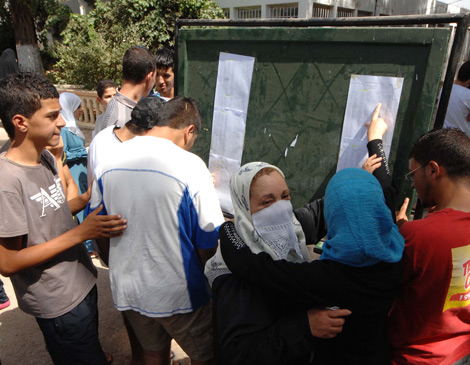
Following weeks of anticipation, the 2026 baccalaureate exam results were unveiled on Sunday, sparking widespread celebration, emotion, and relief across thousands of households. Achieving a national success rate of 56.18%—marking a five-percentage-point increase compared to the previous year—this session reflects a notable upgrade in student performance, restoring confidence to a whole generation preparing to enter university halls.
The 2025/2026 academic year concludes on a highly encouraging note for the national education sector. During a press briefing held to announce the baccalaureate statistics, Minister Mohamed Seghir Saadaoui reported a significant rise in achievement metrics, stating that the recorded figures mirror the dedicated efforts of students, teachers, parents, and the broader educational community.
With the success rate climbing to 56.18%, yielding roughly 47,000 additional high school graduates, the sector chief cautioned against misleading information circulated on social media networks prior to the official announcement, urging candidates to rely solely on the ministry’s official digital platforms. For the minister, this upward trend validates the “positive momentum” pulsing through Algerian schools and serves as a promising indicator for upcoming structural reforms.
Beyond the overall graduation rate, Mohamed Seghir Saadaoui highlighted the exceptional scores of top performers. Specifically, 1,232 candidates earned a GPA equal to or exceeding 18/20, while 21,800 students secured averages ranging between 16 and 18/20. In total, nearly 23,000 graduates cleared the 16/20 threshold.
The minister characterized these high achievers as a “genuine national asset,” noting that they represent strategic potential for the country’s future. “These young minds form an elite that higher education must support under optimal conditions, enabling them to become the researchers, executives, and innovators of tomorrow serving Algeria,” he noted.
The ministry unveiled the identities of the top three individual scorers nationwide. First place was claimed by Querroumi Bouchra Hebat Allah from the Chahid-Bouzira Ahmed High School in the Tiaret province, specializing in technical mathematics, with a stellar average of 19.26/20.
Second place went to Nasrallah Yaquine, a student at the National Mathematics High School in Kouba, originally from Tebessa, who secured a 19.21/20 average, featuring perfect 20/20 marks in core subjects.
The third spot was clinched by Seaal Zineb Douaa, enrolled at a private institution in El-Achour, within the Algiers province, achieving an average of 19.16/20.
Among the Cadets of the Nation military academies, Kedrez Ziad ranked first with a GPA of 18,97/20.
For candidates with disabilities, Merrouche Abdel Basset, a student at the Mohamed-Boudiaf High School in El-Affroun (Blida), posted the highest score in the visually impaired category with 17.57/20. Bekkouche Douaa, from the Setif province, topped the mobility-impaired division with 17.44/20, while a candidate from the Batna province led the hearing-impaired category with 17.05/20.
Regarding Algerian students living abroad, Khalfa Meriem, attending an international school in France, delivered the strongest performance, scoring a 17.38/20 average.
Tizi Ouzou Confirms Its Leadership
Mirroring patterns seen in previous sessions, Tizi Ouzou leads the national provincial rankings with a remarkable 67.15% success rate. It is followed closely by Relizane (66.97%), Chlef (66.07%), Sidi Bel Abbes (63.87%), Ain Defla (63.20%), Bejaia (62.93%), Medea (62.56%), Tiaret (62.54%), Ain Temoucheent (62.50%), and Setif (62.47%).
The minister announced that his department will launch a dedicated support initiative for provinces recording lower results, notably through a pairing system with top-performing regions to foster the exchange of best practices.
According to Saadaoui, these strong outcomes are no accident. They stem primarily from a stable school year, which permitted the complete coverage of academic programs under good conditions and ensured the smooth running of the testing phase.
In this context, he called upon social partners, trade unions, and parent-teacher associations to maintain their commitment to preserving a peaceful climate inside schools. In his view, potential disputes should be settled via constructive dialogue without disrupting student learning.
He particularly highlighted a major innovation introduced this session: administering the exams without enforcing a general internet shutdown or blocking social media applications outside the testing centers, made possible through efficient coordination among relevant public sectors. He hailed this shift as a sign of growing maturity in managing national examinations.
The minister reaffirmed his department’s resolve to press forward with modernizing Algerian schooling. This strategy centers on several core objectives, including expanding foreign language instruction, advancing digital capabilities and artificial intelligence exposure, revising curricula to eliminate outdated content, and offering continuous professional training for educators via international partnerships.
He specifically pointed out the exchange programs sending students to Belarus, alongside the growing availability of specialized training for instructional staff.
Saadaoui renewed his call for parents to become deeply involved in their children’s academic lives. He advocated for the expansion and reinforcement of parent associations at the municipal and provincial levels, viewing their participation as an essential lever to upgrade schooling conditions. The minister cited the example of Tizi Ouzou, where strong family involvement heavily drives the excellent performance recorded across local institutions.