

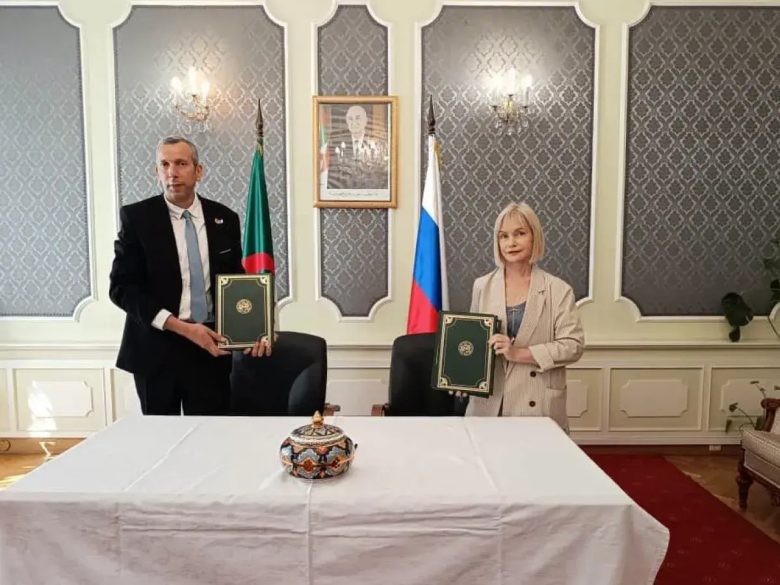
The partnership between Algiers and Moscow has entered a new chapter focused entirely on preserving cultural heritage. Following a scientific and technical agreement signed on Tuesday in the Russian capital, both countries plan to combine their expertise in conservation, restoration, and archaeology, while opening fresh pathways for academic research and professional training. This initiative highlights the strength of Algerian-Russian relations and their shared goal to turn heritage protection into a cornerstone of sustainable cooperation.
The signing ceremony took place alongside the 13th session of the Algerian-Russian Intergovernmental Commission for Economic, Commercial, Scientific, and Technical Cooperation, held in Moscow from June 24 to 26, 2026. This regular summit serves as one of the primary dialogue frameworks between Algiers and Moscow to expand bilateral exchanges across several strategic fields.
Professor Hamza Mohamed Cherif, the director of the National Higher School for the Conservation and Restoration of Cultural Property, signed the agreement for the Algerian side. Dr. Natalia Fedorovna Solovieva, the director of the Rescue Archaeology Center under the Institute for the History of Material Culture at the Russian Academy of Sciences, signed on behalf of the Russian Federation.
This agreement aligns with the broader objective of both states to strengthen their strategic partnership, built on long-standing cooperation across politics, economics, science, technology, energy, higher education, and culture. It also reflects a mutual determination to expand this alliance into fields where sharing technical skills and know-how acts as an essential driver for institutional growth.
In this regard, both parties plan to encourage the exchange of technical skills, knowledge, and practical experiences in restoring historical monuments, protecting cultural property, and designing joint research initiatives. The cooperation will also focus on sharing scientific methods, diagnostic tools, restoration processes, and innovative techniques in heritage preservation.
Prioritizing Rescue Archaeology
The alliance further includes a focus on expanding cooperation in preventive archaeology and rescue excavations, which have become vital for shielding historical remains from urban expansion and modern infrastructure projects. Furthermore, the contract paves the way for specialized training courses, academic exchanges, practical internships, scientific symposiums, and programs tailored to improve the skills of students, researchers, and active heritage preservation professionals.
This cooperation will bring training institutions and research centers from both nations closer together while encouraging the flow of knowledge and the rollout of joint scientific projects.
The Russian Federation maintains a deep scientific tradition in archaeology, monument restoration, and the preservation of cultural property. Over many decades, its research institutes and specialized hubs have built recognized expertise in rebuilding historic monuments, managing salvage archaeology, and applying new technologies to heritage studies. This institutional experience represents a major asset for international partnerships.
On the other hand, Algeria possesses an exceptionally rich cultural legacy that covers every major era of its history. From prehistoric sites and ancient Roman cities to historic medinas, desert ksour, fortifications, Islamic monuments, and numerous UNESCO World Heritage sites, the country holds an inheritance whose preservation remains a vital scientific, cultural, and identity focus. Training local specialists and adopting modern technologies have become top priorities to guarantee the transmission of this heritage to future generations.
Beyond its academic scope, this agreement illustrates the desire of both countries to make heritage preservation a genuine vehicle for cultural cooperation, institutional alignment, and skills development. It also demonstrates the mutual trust that characterizes Algerian-Russian relations and their determination to diversify their strategic partnership.
For the Ministry of Culture and Arts, this initiative fits perfectly into the national plan to modernize the training facilities under its supervision, adopt top international practices, and raise domestic standards of heritage conservation and restoration to match global scientific benchmarks.