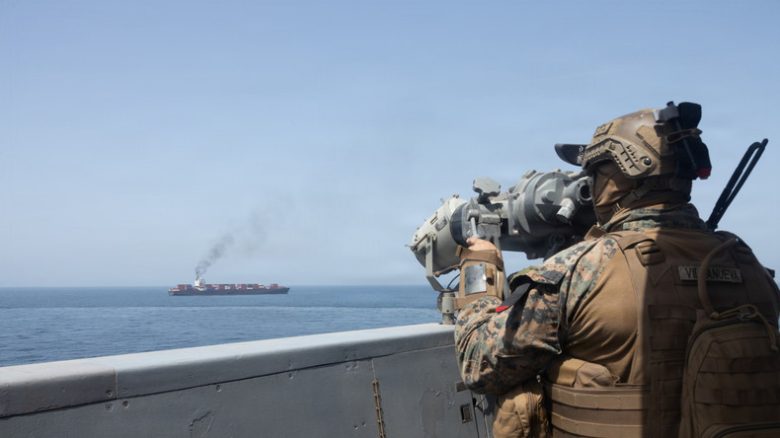
Iran and the United States have traded fresh military strikes around the Strait of Hormuz, targeting multiple installations across the Gulf. Each side justifies its maneuvers through a framework of retaliation and self-defense. Middle Eastern nations remain caught in the middle of these frictions, while oil markets are shifting in response to the flare-up. Anxieties between Tehran and Washington crossed a new threshold this Wednesday, June 10, following a sequence of assaults and counter-assaults carried out around the strategic chokepoint. Tehran maintains that it targeted several American military outposts in the Gulf region, specifically in Jordan, Bahrain, and Kuwait, as payback for American raids directed at Iranian facilities in the southern part of the country. For its part, Washington rationalizes its missions as a reaction to the downing of a US Apache helicopter, claiming “proportionate” operations against Iranian defense apparatuses. A managed escalation? On the ground, Iran’s Revolutionary Guard Corps stated they zeroed in on specific military assets, including an airfield in Jordan and units connected to the US Fifth Fleet in Bahrain. The United States asserts it neutralized radar stations, command nodes, and anti-aircraft infrastructure near the Strait of Hormuz, an incredibly sensitive zone for international energy shipping. A number of Gulf states, including Kuwait and Bahrain, triggered their defensive grids in response to incoming aerial hazards detected within their airspace. Under these circumstances, public declarations from both opponents fit into a narrative of calculated confrontation, where every move is framed as a direct answer to an antecedent provocation. Iran emphasizes the reactive nature of its maneuvers, while the United States highlights self-defense and escalation control. Despite the expanding exchange of fire, no slide into an unrestricted conflict has been detected at this juncture. This episode is part of a broader cycle of regional frictions where Middle Eastern territories find themselves on the front lines, vulnerable to clashes that extend far beyond their borders. Crude markets reacted instantly, underscoring the strategic weight of this corridor within the global economy. The entire situation thus presents itself as another chapter in a recurring standoff, defined more by the logic of deterrence than by an absolute military rupture.
Yet Another Escalation in Iran: Washington Claims To Strike Back