

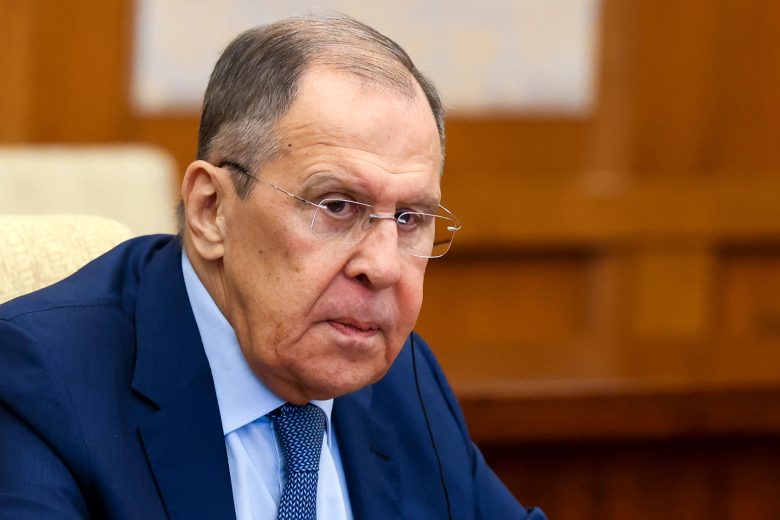
Russia’s Foreign Ministry has responded to comments by the French ambassador in Moscow, Nicolas de Rivière, concerning the interview granted by Russian Foreign Minister Sergueï Lavrov to France Télévisions. Moscow describes the ambassador’s remarks as a “own‑goal” and accuses Paris of defending media freedom in a selective way, especially when the Russian voice challenges the dominant Western narrative.
The Russian foreign ministry issued a statement on 25 April addressing the ambassador’s declarations. The French diplomat had presented the broadcast of Lavrov’s interview on France Télévisions as a sign of France’s commitment to press freedom. Moscow rejects this interpretation. For Russian diplomacy, the episode instead reveals the limits of the pluralism Paris claims to uphold.
After the interview aired, France Télévisions came under fierce criticism in France and in several other Western countries for giving the Russian foreign minister a direct platform. Moscow sees an obvious contradiction: Paris affirms that it defends freedom of expression, yet that freedom is suddenly questioned whenever a Russian official can speak directly to the public. The Russian ministry therefore characterizes de Rivière’s remarks as a “self‑inflicted own‑goal.”
The statement also recalls the reactions of the former French minister Nathalie Loiseau, now a European MP, and of the deputy Laurent Mazaury, who referred the case to the media regulator Arcom over France 2’s decision to broadcast the interview. For Moscow, these positions illustrate a broader Western tendency to accept debate only as long as it remains within a politically acceptable framework.
Russian media hit by restrictions
The Russian ministry situates this controversy in a wider context. It recalls that Russian media have faced repeated restrictions in France. As early as Emmanuel Macron’s 2017 presidential campaign, the outlets RT and Sputnik were denied accreditation. After his election, their journalists ran into obstacles when trying to attend official events at the Élysée. The statement cites further examples, including difficulties for Russian reporters at government press briefings and the withdrawal of accreditations for correspondents from TASS during the Paris Olympic and Paralympic Games in 2024.
Moscow also highlights decisions by Arcom, which adopted measures in February 2026 to block 35 Russian media websites. The ministry argues that these measures are not isolated incidents but part of a policy pursued by France and the European Union since 2022 against Russian media outlets.
The Russian foreign ministry points to French laws adopted in 2018 against “information manipulation” and in 2024 on preventing foreign interference. In Moscow’s view, these texts strengthen political control over information and make it easier to sideline media outlets deemed undesirable.
Moscow contrasts with treatment in Russia
The Russian statement then draws a sharp contrast with conditions for French journalists in Russia. The ministry notes that 36 staff members from seven French media outlets are currently accredited on a permanent basis by its services. They have regular access to major official events, including press conferences given by the Russian president and the foreign minister.
Disagreement moving into the political arena
This criticism is not confined to the media sphere. In the same communiqué, Russian diplomacy also challenges the idea that France harbours no hostility towards Russia. The ministry recalls Emmanuel Macron’s description of Russia as an “existential threat” to France and Europe, as well as comments by the French armed forces chief, Fabien Mandon, about the prospect of a military confrontation with Moscow in the coming years.
Moscow also takes issue with France’s stance on Ukraine. It dismisses as “fantastic” the proposals put forward by the so‑called “coalition of volunteers” promoted by Paris and argues that France is trying to push parallel initiatives that ignore the real situation on the ground and the existing framework of negotiations.