

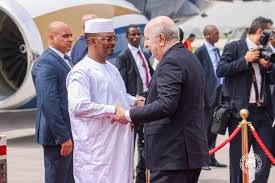
The official visit of Chadian President Mahamat Idriss Déby Itno to Algiers was marked by a clearly stated ambition to elevate Algerian–Chadian relations to the status of an integrated strategic partnership. At the end of their talks this Friday evening, the two heads of state—the Algerian President Abdelmadjid Tebboune and his Chadian counterpart Mahamat Idriss Déby Itno—reaffirmed their shared determination to move beyond traditional ties and build a more structured, multidimensional cooperation focused on economic, security, and broader African priorities.
At the heart of their discussions lay a clear intent to shape a new phase in bilateral relations. In a joint statement, President Tebboune highlighted the significance of the progress achieved, describing it as “an important step toward constructing an integrated strategic partnership,” while reiterating Algeria’s commitment to support Chad in its development efforts. He also underscored the African dimension of this dynamic, suggesting that the aim is to build “a successful African model of inter‑African cooperation,” anchoring the relationship in continental solidarity and integration.
President Tebboune noted that this visit continues the momentum launched during the previous meeting between the two leaders and is intended to “provide a new impetus to cooperation in various fields, particularly in the economic sphere.” Priority sectors identified include energy, mining, infrastructure, transport, industry, and the pharmaceutical industry. The Algerian leader also stressed the need to update the legal framework governing bilateral relations, mentioning the prospect of nearly “30 agreements and memoranda of understanding” that will structure this new chapter.
Institutionally, the revival of the mixed cooperation commission was presented as a key lever. Both sides agreed to accelerate its work, with an emphasis on monitoring and tangible results. The Algerian–Chadian Business Council was also highlighted as a tool to energize economic exchanges between companies from the two countries.
Human and academic cooperation was not overlooked. Algeria reiterated its readiness to expand the training of Chadian officials in various fields, as part of a strategy aimed at transferring skills and know‑how to support Chad’s development.
On the security front, the talks focused on shared challenges in the Sahel–Sahara region. President Tebboune noted that “the challenges facing our common region in the Sahel, especially the fight against terrorism, require coordination and cooperation,” emphasizing the importance of a joint response to safeguard regional stability.
For his part, President Mahamat Idriss Déby Itno offered a more historical and political reading of the relationship, stating that “my presence in Algeria reflects a clear political will to move from traditional friendship to a new‑generation strategic partnership.” He recalled the depth of the ties between the two countries, stressing that they “are not linked by chance but share a historical depth rooted in the trans‑Saharan route and a political vision forged by our founding fathers.”
More broadly, the Chadian President described the current dynamic as a turning point, saying that the agreements concluded rest on four pillars: knowledge, resource transformation, economic integration, and security. He also highlighted the symbolic value of the air connection between Algiers and N’Djamena, portraying it as a model of rapid, concrete cooperation.
Overall, this visit consolidates, beyond the purely political axis, a strategic realignment in relations between Algiers and N’Djamena. It reflects a shared determination to move beyond conventional bilateralism and embed the partnership within a broader African‑integration logic, where South–South cooperation becomes a key driver of development and regional stability.