

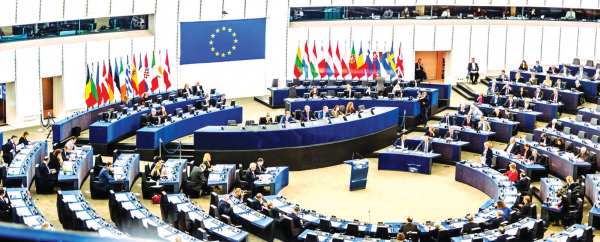
What seemed unimaginable just a few months ago has now become the focal point of the European political debate. Under pressure from an unprecedented civic mobilization and a massive wave of support from senior diplomats, the European Commission’s isolation on the Israeli file has never been more visible.
The diplomatic dam has cracked. More than 350 former ministers, ambassadors, and high‑ranking European Union officials are calling on Wednesday for the suspension of the association agreement between the EU and Israel, denouncing its policy of “enslavement” and “illegal occupation” of Palestinian territories. This agreement, which forms the legal backbone of commercial and political relations between the two parties, is now under direct attack.
For these ex‑leaders, maintaining this partnership has become incompatible with the realities on the ground in Gaza, where accusations of genocide and war crimes weigh heavily on the international conscience. The accord, signed in 1995 and fully in force by June 2000, sets the framework for trade and political ties under which Israel has been integrated into several EU‑wide programs, including the Euromed partnership. Article 2 of the agreement states that relations rest on “respect for human rights and democratic principles,” principles the signatories accuse Israel of systematically breaching.
A breach of principles and an appeal for action
“While the world’s attention is drawn elsewhere, Israel, under the pretext of illegal military operations against Iran and Lebanon, has continued to enslave the Palestinian population in Gaza and the West Bank, including East Jerusalem, intensifying its illegal occupation policy,” reads the open letter, which has circulated since Wednesday on social media. The signatories, including Josep Borrell, former president of the European Parliament and ex‑head of EU foreign policy, argue that “the current Israeli government is violating the EU’s core principles toward the Palestinians, for whom it remains legally and morally responsible as an occupying power.”
They further claim that Israel’s actions “constitute a violation of Article 2 of the EU‑Israel association agreement.” Accordingly, they urge the leaders of the 27 member states to “take measures to suspend all or part of the EU‑Israel association agreement” and to “end trade in military equipment with Israel,” among other steps. “In this period of turmoil in the Middle East and in the face of Israel’s widespread violations of international law, it is imperative that the EU act and hold Israel to account,” they write.
At the same time, grassroots pressure has reached a historic milestone. The European Citizens’ Initiative (ECI) launched to demand sanctions has officially exceeded one million signatures. “This is no longer just a petition; it is a binding legislative tool,” organizers emphasize. By crossing this threshold, European citizens now legally compel the European Commission to formally address the issue. The stated goal is to reach 1.5 million signatures and further tilt the balance of power in favor of tougher measures.
A widening gap between leaders and public opinion
The gap between EU leadership and public opinion has become striking. In 26 out of 27 member states, a majority of the population now supports suspending the EU‑Israel trade agreement. Meanwhile, European Commissioner Dubravka Šuica still defends a policy of “constructive dialogue,” a phrase that increasingly sounds out of sync with the humanitarian emergency unfolding in Gaza.
For years, the EU has been accused of silent complicity toward Israel. Today, treating Israel as a “normal partner” is no longer sustainable. The nature of the debate has shifted: the question is no longer whether suspending the agreement is legitimate, but when it will be implemented. For the millions of signatories and the hundreds of senior officials involved, the campaign will not end until the commercial link is severed, marking the end of what they see as Israel’s diplomatic impunity.