

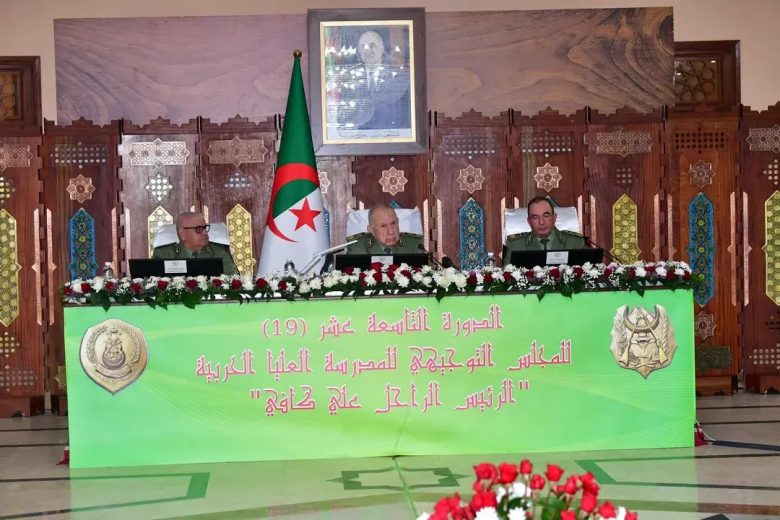
In a global system undergoing rapid upheaval—where this Friday’s certainties yield to chronic volatility—Algeria is reshaping its power doctrine. Recent directives from Army General and Defense Vice-Minister Saïd Chanegriha, aligned with President Abdelmadjid Tebboune’s vision, signal a pivotal shift: from historical legitimacy to systemic, multifaceted strength.
The opening assessment in his speech cuts straight to the core. A nation’s stance can no longer rely solely on nostalgic displays of anti-colonial triumphs. While past victories form the bedrock of identity, they must fuel today’s operational edge.
“Our bond with our glorious history isn’t an end in itself but a spark to build might that commands respect now,” declared the ANP Chief of Staff last Thursday during the 19th session of the Higher War School’s Orientation Council.
The new world order demands “active engagement.” Algeria rejects passive acceptance of dictated balances, aiming instead to emerge as an indispensable hub through economic, societal, and institutional resilience.
At the heart of this transformation, the National People’s Army (ANP) is undergoing its own overhaul. Defense systems now form a holistic ecosystem, prioritizing technological sovereignty via mastery of cutting-edge tools. Military leaders stress adapting to “next-generation warfare,” where electronics and drones reshape battlefields. Human capital is the game-changer. The Ukraine conflict serves as a global testbed for these modern wars. Clearly, the ANP recognizes a key tech shift: the end of dominance by traditional heavy armor. Low-cost drones and precision cyber strikes have neutralized pricey tanks and ships, upending power dynamics. Meanwhile, Algeria positions itself as a “stability anchor” amid rising militarization of seas and lands, fueled by Middle East tensions and Iran-adversary escalations. Sahel unrest, plus ripples from Near East clashes, exerts steady border pressure.
Thus, cultivating expertise in these technologies is paramount. “Skilled human resources remain the cornerstone of any effective defense strategy—technology without the patriotic, aware operator is soulless,” stated Mr. Chanegriha. Another cornerstone shaping this approach is industrial self-reliance.
The Push for Domestic Production
Localizing the defense industry is the ultimate security lock—especially with disrupted global supply chains. The goal: ramp up a homegrown military sector to craft its own defense gear, slashing external dependencies for unfettered decision-making.
A hallmark of the current doctrine is addressing “intangible threats.” In an age of disinformation and algorithmic meddling, the battlefield extends to media realms. “Today’s wars don’t just target land—they aim to seize minds and shatter national unity via cyberspace and social platforms,” noted the Defense Vice-Minister. Like disinformation barrages in major ongoing conflicts, Algeria sees itself as a potential hybrid warfare target.
The military institution calls for crafting a unifying national narrative—a psychological shield. It’s no longer just about physical borders; it’s dismantling manipulation tactics that erode trust between people and state pillars. Algeria must leverage its energy might, geographic gateway to Africa, and diplomatic clout with forward planning. This targeted strategy turns assets into tangible influence levers. “We must wisely harness our strategic edges to cement our role as a key regional influencer and stabilizer,” the Army General emphasized.
The message rings clear. In a world unkind to the weak, Algeria opts for proactive power. By fusing military strength, economic toughness, and a robust national story, the country equips itself to navigate the stormy seas of the emerging global order.