

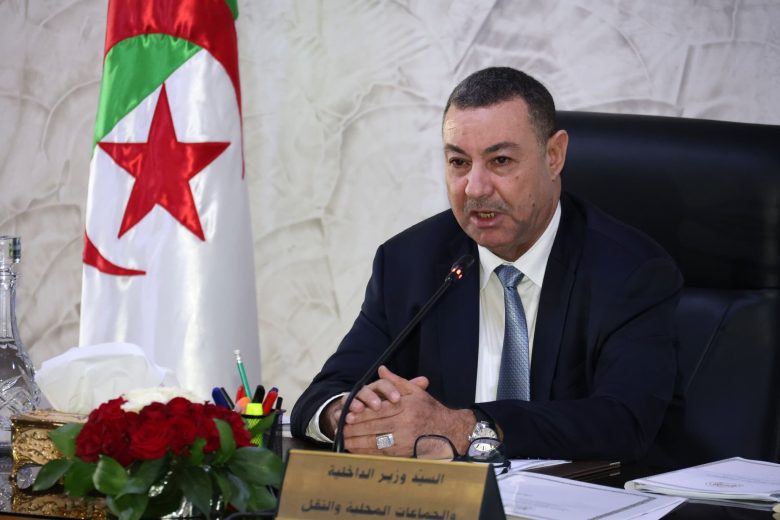
The organic bill on political parties aims to restore order in national political practice by establishing clear rules based on transparency, accountability, and respect for the state’s constants, while strengthening the role of parties in institutional building and the country’s stability. This is what Interior Minister, Local Authorities, and Transport Minister Saïd Sayoud stated this Sunday.
Mr. Sayoud affirmed that the organic bill on political parties has the main objective of working to “reorganize political practice on more effective constitutional, legal, and institutional bases,” in order to make political formations “a true foundation for building strong and credible institutions.”
Presenting the text before the National People’s Assembly (APN) Committee on Legal, Administrative Affairs, and Freedoms, the minister explained that this bill is part of a fundamental approach to “consolidate the rule of law, strengthen national stability, and restore confidence in political action.” He added that it also aims to enable political parties to fully play their role in animating democratic life and building solid institutions based on legitimacy and accountability.
Recalling “the constant commitment of the President of the Republic, Abdelmadjid Tebboune, to opening up the political field,” Mr. Sayoud indicated that the drafting of the bill is based on “in-depth studies and broad consultations” involving political actors, university elites, and legal experts. He specified that “this approach has made it possible to develop a clear, coherent, and balanced legal framework, guaranteeing parties the exercise of their activities in compliance with transparency, accountability, and political pluralism.”
Comprising 97 articles divided into seven chapters, the bill grants political parties “a broad field of action allowing effective participation and real integration into national political life,” assured Mr. Sayoud, emphasizing that it guarantees them “the means of organization, expression, and political action,” while opening the possibility “to challenge administrative decisions before competent courts.”
Mr. Sayoud took care to specify that the goal is to “elevate the status of the political party and strengthen its central role in managing public affairs” by expanding its areas of intervention. Parties will thus be called upon to contribute to implementing the government’s general policy, to formulate proposals, and to issue opinions on public service management and the development of public policies.
In return, the text imposes on political parties “strict respect for the provisions of the Constitution, the fundamental values of Algerian society, national identity, and the state’s constants,” particularly those related to sovereignty, national defense, and security. It also regulates partisan behavior through “a set of principles and ethical rules designed to promote healthy, democratic, and responsible political practice.”
The minister also indicated that the bill explicitly prohibits “any partisan activity based on religious, regional, or ethnic grounds,” as well as any practice “likely to undermine national sovereignty, public order, or democratic values,” adding that it also bans “establishing relationships of dependence or subordination with foreign interests or parties.”
In the same spirit, the bill seeks to put an end to political nomadism through the introduction of dissuasive legal sanctions, including “forfeiture of the elective mandate and permanent removal of the elected official from his party’s lists.” A measure whose prospect, the minister argues, is to “enshrine political ethics and preserve the credibility of partisan action.”
Furthermore, the text sets new conditions and procedures for the creation and approval of political parties, while allowing them “to form alliances or proceed with mergers within a clear and precise legal framework,” with “the possibility of cancellation in case of violation of legal provisions,” indicated Mr. Sayoud.
Regarding internal organization, the minister explained that the bill enshrines “the principle of democratic alternation as a fundamental rule of partisan functioning.” He emphasized that it provides in particular “for limiting the party leader’s term to five years, renewable only once,” a provision intended to “ensure balance, stability, and renewal of leadership bodies.”
Addressing the issue of party financing, the minister indicated that the text emphasizes “transparency and integrity in the financial management of parties” through “the prohibition of foreign financing, the obligation to declare donations and contributions, account audits, and the submission of an annual financial report.”