

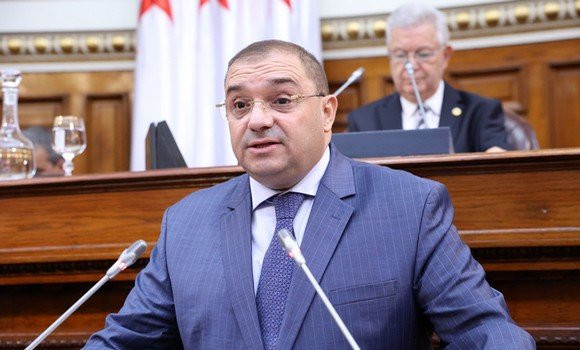
In the context of examining legislative texts transmitted to the Council of the Nation after their adoption by the People’s National Assembly, the Minister of Justice, Keeper of the Seals, Lotfi Boudjemâa, presented a detailed report this Monday to the Commission on Legal and Administrative Affairs, Human Rights, Local Organization, Territorial Planning, and Territorial Division. These are the organic law project on the status of the judiciary, as well as a bill amending and supplementing Ordinance No. 70-86 of December 15, 1970, relating to Algerian nationality.
Regarding the organic law project on the status of the judiciary, the Minister of Justice indicated that this text “is part of the implementation of the commitments of the President of the Republic, Abdelmadjid Tebboune, aimed at promoting justice, strengthening the role of the judicial power, and adapting the legal arsenal to constitutional developments.”
He specified that the project, consisting of 110 articles, “is based on an architecture articulated around several fundamental axes,” particularly “strengthening the prerogatives of the Superior Council of the Judiciary in managing the careers of judges, consolidating the independence of the judge, preserving their dignity, and guaranteeing their impartiality, while introducing measures aimed at improving the functioning of the public justice service.”
The Keeper of the Seals recalled, in this context, that the status of the judiciary in force since 2004, developed under the 1996 Constitution, is no longer in line with the political, institutional, and social transformations the country is undergoing. He emphasized that “the 2020 Constitution has explicitly enshrined the independence of the judicial authority, which requires adapting the legal framework governing the judicial profession.”
The Keeper of the Seals also presented the bill amending and supplementing the ordinance on Algerian nationality, explaining that “this initiative fits into a specific national and constitutional context, marked by the need to protect the sovereignty of the State and consolidate the legal foundations of citizenship.”
He specified that this text “aims primarily to adapt the provisions relating to the acquisition, loss, or withdrawal of nationality to constitutional requirements and Algeria’s international commitments, particularly regarding exceptional situations of deprivation of nationality.”
Mr. Boudjemâa assured that “the revision of the rules relating to nationality constitutes a strictly exceptional measure,” which “can only be applied in cases of extreme gravity, linked to State security, national unity, or the supreme interests of the country.” He cited, in this regard, “acts of high treason, intelligence activities on behalf of a foreign power, attacks on national cohesion, or the abusive exploitation of dual nationality to the detriment of the original Algerian nationality.”
The minister stressed that “this text in no way calls into question the principle of dual nationality,” but that it “aims to address situations of misuse of it to evade responsibilities or harm State security.”
Following the minister’s presentation, “a rich and in-depth debate” took place within the commission, marked by interventions and observations from members of the Council of the Nation on the various legal, institutional, and administrative aspects contained in the two texts examined.
These exchanges helped enrich parliamentary reflection around reforms described as structural, both for the future of the judicial institution and for the protection of the legal foundations of the State and citizenship.