

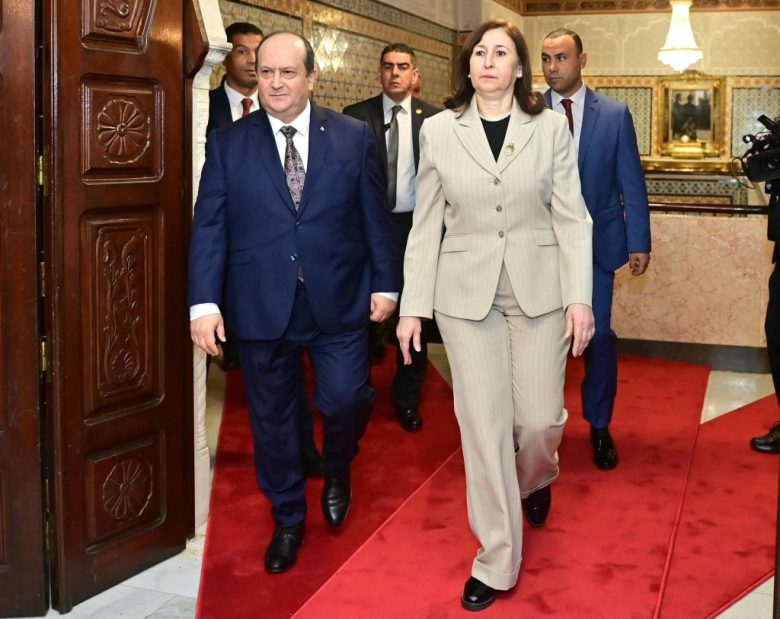
During the 23rd session of the Algerian-Tunisian Joint Commission, which they co-chaired, Prime Minister Sifi Ghrieb and Tunisian Head of Government Sarra Zaafrani Zenzri affirmed, this Friday in Tunis, the two countries’ determination to transform their political partnership into a true strategic alliance, based on security, economic and cultural cooperation, as well as solidarity in the face of regional and international challenges.
In his speech at the opening of the bilateral meeting, Mr. Ghrieb stated that “the initiative for this session aims to elevate our bilateral relations to the level of an integrated and solidary strategic partnership.” He emphasized that this approach aligns with the instructions of Presidents Abdelmadjid Tebboune and Kaïs Saïed.
The Prime Minister also highlighted the importance of this session for reviewing achievements since the last meeting, held in Algiers in October 2023, and projecting the future of the bilateral partnership. He noted that “our relations have reached a level of maturity that allows us to speak with complete frankness and objectivity, to strengthen what is beneficial and correct what is less so, through innovative and tailored mechanisms to remove obstacles to our ambitions.”
He recalled that the follow-up commission, co-chaired by the Foreign Ministers—Ahmed Attaf for Algeria and Mohamed Ali Nafati for Tunisia—ensures the monitoring of recommendations and cooperation strategies across various sectors. This structure is essential for translating political ambitions into concrete actions and structuring sustainable and effective cooperation, he stressed.
Another key topic addressed was security, the strategic foundation of the Algerian-Tunisian alliance. Mr. Ghrieb underscored that continuous monitoring between the two countries enables them to combat terrorism, cross-border crime, clandestine immigration, and drug trafficking. The 2nd meeting of the joint security commission, held in Algeria in July 2025, assessed the regional situation and its impacts, confirming that “joint work is progressing in stable and reassuring stages.”
The signing, in October 2025, of a military cooperation agreement marks a strategic turning point, providing a legal framework for coordinating operations and intelligence exchanges, thereby strengthening the two countries’ capacity to counter transnational threats in the Sahel and Mediterranean regions.
The Prime Minister specified that this cooperation seeks to establish a true integrated strategy combining prevention, operational action, and diplomatic coordination, emphasizing the importance of pooling resources and technical expertise.
In response to terrorism and cross-border crime, Algeria and Tunisia are strengthening their cooperation through intelligence sharing, coordinated patrols, and preventive measures. This joint approach, which transcends national borders, positions the two countries as stabilizing actors in the Mediterranean and Sahel, sharing a common vision on major regional and international issues.
Algeria and Tunisia reaffirm their support for the Palestinian people to establish an independent state with Al-Quds as its capital and condemn aggressions in Lebanon and Syria. Regarding Libya, they advocate for an internal political solution led by Libyans, including legislative and presidential elections to build strong institutions and preserve the country’s resources.
In the same vein, Algeria and Tunisia commit to supporting Sudan’s stability and unity by backing national dialogue and protecting the country’s resources and sovereignty.
While security and diplomacy structure the partnership, human and cultural ties form its foundation. “Our peoples share culture, history, language, religion, and a common history of struggle,” Mr. Ghrieb reminded. This human capital fosters solidarity, encourages academic and scientific exchanges, and develops cultural cooperation through reciprocal centers and joint events.
For her part, the Tunisian head of government praised “the excellence of bilateral relations” and the regular holding of this session, a strong sign of the shared will to build a solid political partnership. She also highlighted the importance of strengthening coordination mechanisms to ensure sustainable and effective cooperation.