

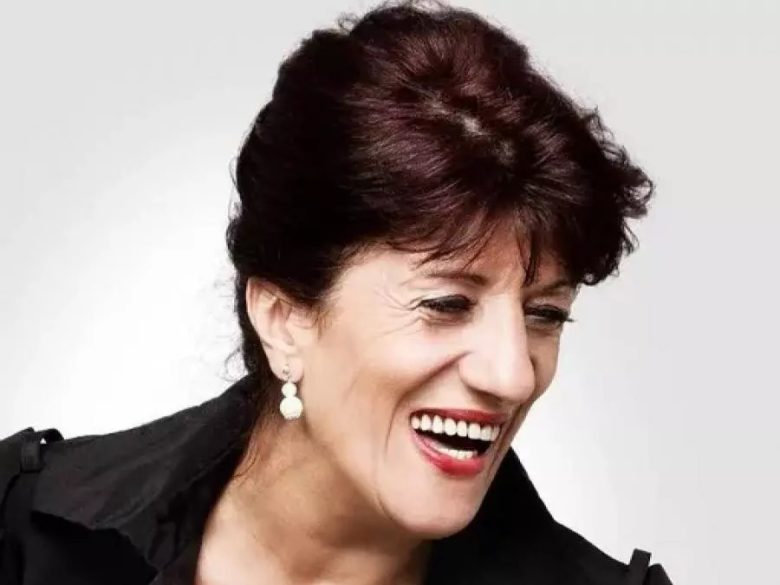
Biyouna, whose real name was Baya Bouzar, a renowned singer, comedian, and actress, passed away this Tuesday at the age of 73 at Beni Messous Hospital in Algiers. She will be remembered for a body of work that earned her the admiration of a wide audience beyond Algerian borders, thanks to her legendary frankness and memorable characters.
The artist had been battling cancer since 2016 and suffered from severe respiratory failure, which required numerous hospitalizations in recent weeks until her breath finally faded. Born on September 13, 1952, in the Belouizdad neighborhood (formerly Belcourt) in Algiers, Baya Bouzar was drawn early on to singing and the stage. As a teenager, she joined several musical groups. She initially was part of Fadhéla Dziria’s group, providing backing vocals, before leading her own small ensemble with her friend Flifla. She quickly established herself as a sought-after entertainer for weddings and celebrations in Algiers.
At 17, she was already performing in the city’s major cabarets. At 19, she became a dancer at the Copacabana, and it was during this period that director Mustapha Badie noticed her. He offered her first role in the television series “La Grande Maison” (1973), adapted from Mohamed Dib’s novel. She played Fatma, a role that revealed her to the public and definitively launched her career. Biyouna truly began her cinema career at 22. She appeared in numerous Algerian productions and gradually became a staple face on television. Her career includes a multitude of films, TV movies, and series, smoothly transitioning between comedy and drama.
Her career took on an international dimension, with a notable presence in France starting in 1999, when filmmaker Nadir Moknèche cast her as Meriem in “Le Harem de Madame Osmane.” The director then gave her two other prominent roles in “Viva Laldjérie” (2003) and “Délice Paloma” (2007). The artist also appeared in several French productions, including “Les Trois Frères: Le Retour” (2014), “Neuilly sa mère, sa mère!” (2018), and “Le Flic de Belleville” (2018), alongside Omar Sy. She held main roles in many films such as “Le flic de Belleville” (2018), the short film “On va manquer” (2018), “Les Trois frères” (2014), “Le Harem de Madame Osmane” (2000), “Les Vacances de l’apprenti” (1999), and “Leïla et les autres” (1978). Her performance in “À mon âge je me cache encore pour fumer” (2017), marked by bold scenes, made a strong impression.
Biyouna left a lasting mark on audiences through the trilogy “Nass Mlah City” (2002–2005), a true Ramadan phenomenon in Algeria, and through her role in the Tunisian sitcom “Nsibti Laaziza” aired in 2010, which she continued until season 6. She also participated in the show “Opéra d’Casbah” by Fellag. Her last screen role was in “Dar Lefchouch” by Djafar Gacem (2023).
Despite success in cinema, Biyouna never abandoned her first passion, music. In 2001, she released her first album, “Raid Zone,” a collaboration with composer John Bagnolett. She continued in 2004 with “Une Blonde dans la Casbah,” created with musicians and arrangers like Joseph Racaille and Christophe Dupouy. In 2011, she lent her voice to the song “Bergman” by Julien Doré for the album “Bichon.”
Alongside cinema and music, Biyouna regularly explored theater. She took part in demanding productions, such as “Electra” by Sophocles alongside Jane Birkin in 2006. In 2009, she played “La Célestine” at the Vingtième Théâtre in Paris. Directed by Ramzy, her first solo show, “Biyouna!,” was performed in 2012 at the Théâtre Marigny. Her artistic talent, blending sensuality, exuberance, humor, and nostalgia, shaped a uniquely distinctive artistic persona.
Regarding the circumstances of her passing, the artist was first hospitalized on November 4 at Baïnem Hospital before being transferred to the pneumology department of Beni Messous, where her condition rapidly worsened. She suffered from severe respiratory failure, complications related to oxygen saturation, and effects of cancer diagnosed in 2016, according to reported information. Despite a long battle with the illness, she continued working when her health allowed, preserving until the end the image of a tenacious artist deeply connected to her audience.
With over half a century of career, Biyouna leaves behind a rich and inspiring filmography. The loss of this figure has deeply affected her loved ones, the public, and the entire cultural community. Her contribution to Algerian and Franco-Algerian culture currently inspires extensive homage in both Algeria and France.
President Abdelmadjid Tebboune expressed “his sadness after losing one of the stars of the Algerian cultural scene,” highlighting her role in promoting national cinema.
A multidisciplinary artist, Biyouna marked different generations with her sharp humor, straightforwardness, and ability to portray complex and deeply human female characters. Between stage exuberance and keen dramatic sense, she built a unique body of work at the crossroads of theater, cinema, and music. Biyouna has passed away, but her legacy remains.