

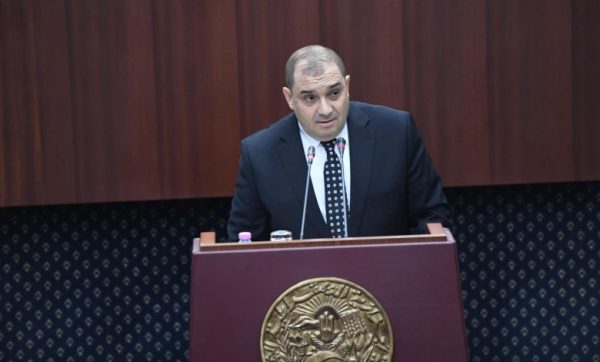
Presenting the draft organic law on the status of the judiciary before the Legal Affairs Committee of the National People’s Assembly, the Minister of Justice and Keeper of the Seals, Lotfi Boudjemâa, defended a profound reform aimed at aligning the judicial body with the requirements of the 2020 Constitution. This text, which redefines the prerogatives of the Higher Council of the Judiciary and strengthens guarantees of judges’ independence, seeks to modernize the functioning of justice, enhance magistrates’ training, and bolster the transparency of the judicial system.
The minister stated upfront that “the currently applicable law, promulgated in 2004 under the 1996 Constitution, no longer meets, over time and with changes, the demands of the political, social, and institutional context.” He emphasized that the new draft is part of “a comprehensive reform vision intended to strengthen judicial independence, guarantee career transparency, and improve the functioning of the public justice service,” clarifying that composed of 110 articles divided into three main sections, the draft organic law aims to “provide the judiciary with a modern, coherent framework consistent with the constitutional principles of 2020.”
The first axis concerns the recognition of the role of the Higher Council of the Judiciary (HCJ) as the single body responsible for managing the judge’s career, “from appointment to retirement.” Mr. Boudjemâa explained that the text provides that “the permanent bureau of the Council, in coordination with the Ministry of Justice, will handle the allocation of new judges within the different jurisdictions.” It also assigns the Council the task of approving magistrates’ continuous and specialized training programs, granting it new prerogatives regarding authorization of ancillary activities and monitoring career paths. Furthermore, the draft introduces new qualifying judicial positions allowing access to the Supreme Court and the Council of State, through the position of assistant judge, for which the Higher Council of the Judiciary will have approval and appointment powers.
The reform’s second axis aims, the minister assured, “to consolidate judicial independence and preserve the dignity of the judiciary.” The draft regulates conditions for magistrates’ transfers, balancing the needs of the public justice service with the personal interests of those concerned. Judges may request transfers either during the annual movement or “for exceptional reasons provided by the organic law related to the Higher Council of the Judiciary.” The minister highlighted that the text guarantees “new rights for judges,” notably “the right to union activity, leave benefits, and state protection in case of aggression or threats linked to the exercise of their functions.”
Wishing to reinforce magistrates’ neutrality, Mr. Boudjemâa stressed the prohibition on judges from “joining a political party, holding an elective political mandate, or engaging in any lucrative activity,” except “teaching and training,” subject to approval by the president of the HCJ permanent bureau.
Moreover, the minister detailed disciplinary provisions, stating that “the draft precisely defines serious professional faults that may lead to the dismissal of a magistrate, as well as the guarantees recognized for them within the disciplinary procedure.” He added that “the power to suspend a judge will now be transferred to the Higher Council of the Judiciary” and procedures for abandonment of post will be “simplified, clear, and accompanied by strictly regulated deadlines.” The text also guarantees “respect for the judge’s right of defense at all stages of the disciplinary procedure.” To separate investigative and decision-making powers, the minister specified that “the General Inspectorate of the Ministry of Justice will be responsible for initiating disciplinary proceedings on behalf of the Keeper of the Seals,” aiming to “entrench the principle of separation between prosecution authority and judgment authority.”
Regarding training, Mr. Boudjemâa emphasized the “central role of the Superior School of the Judiciary,” charged with providing “basic training for student magistrates” and coordinating with the HCJ for “implementation of continuous and specialized training programs.” He noted that “the draft pays particular attention to the qualification of judges, essential actors in protecting rights and freedoms and guarantors of social justice.” The text also maintains the possibility to extend magistrates’ active service beyond the retirement age, up to 65 years for judges of administrative courts and courts of appeal, and up to 70 years for those of the Supreme Court and Council of State, with the possibility to use their expertise under contract.
The draft organic law provides for a renewable one-year probationary period for magistrates graduating from the Superior School of the Judiciary, during which they cannot render judgments or order provisional detentions. It specifies their professional duties, including the prohibition on using social media to discuss judicial matters. The goal is to strengthen transparency, competence, and judicial independence, in line with constitutional commitments to a modern and fair justice system.