

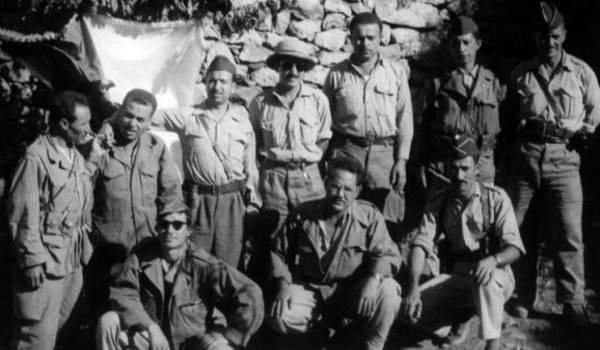
At the origin of the outbreak of the armed struggle, history will remember that among the 21 + 1 initiators of the revolutionary movement, more than two-thirds came from the Greater Constantine region, and among them six were from the city of Ponts. Rabah Bitat, Ramdane Benabdelmalek, Slimène Mellah, Mohamed Mechati, Youcef Zighoud, and Saïd Bouali all spent their childhoods within Constantine families.
Almost all came from modest families; only Ramdane Benabdelmalek, the youngest among them, had managed to complete secondary education. The others were forced, due to the colonial yoke or family necessity, to leave school early to help their relatives. Youcef Zighoud was able to acquire the precepts of Islam in the Quranic school in his village at Smendou, alongside French schooling, where he earned his primary school certificate. All were members of the Algerian People’s Party; some joined the Special Organization or the Movement for the Triumph of Democratic Liberties.
These social trajectories partly explain these militants’ closeness to rural and popular communities, the human and logistical groundwork of the Revolution, and many enjoyed strong social roots. Youcef Zighoud, for example, maintained strong ties with the countryside and artisans, facilitating the creation of a local network essential for the transition to armed action.
Though most contested the method of assigning responsibilities within the revolutionary hierarchy at a crucial moment before the armed struggle began, especially regarding the representation of zones, all nevertheless joined the armed fight. Some, like simple soldiers of the National Liberation Army, died almost at the dawn of November 1, like Saïd Bouali and Slimène Mellah. Ramdane Benabdelmalek also died too early, being the first among the group of 21 to fall on the field of honor, on November 4, 1954, near Mostaganem. Youcef Zighoud, architect of the legendary attack in Northern Constantine, would die less than two years later.
Only Rabah Bitat and Mohamed Mechati survived and witnessed the achievement of independence. The two men even held positions of responsibility in the young Republic’s government. Rabah Bitat, president of the Popular Assembly from 1977 to 1990, was interim president upon the death of Houari Boumediene between December 1978 and February 1979. He died in 2000 in Paris. The highest official post held by Mohamed Mechati was ambassador and vice-president of the Algerian League for Human Rights. He was known for his opposition to the ousted president Abdelaziz Bouteflika and passed away in Geneva in 2014. In one of his statements, the late Mohamed Mechati explained that the strong representation of Greater Constantine was due to the mission to bring together the group of 21 at Clos Salembier, at Derriche Elias’ villa, being entrusted to the late Mohamed Boudiaf, then head of Northern Constantine within the Special Organization, who surrounded himself mostly with people he trusted.
Among the members of the group of 21 from today’s eastern capital, Youcef Zighoud helped give new breath to the Revolution at a time when colonial forces were intensifying their ferocity against anyone suspected of waging war against them. The August 20, 1955 offensive in Northern Constantine, among other armed actions of Algerian militants, was a “true detonator” of the armed struggle, organized and led by Youcef Zighoud.
It marked a decisive turning point for what followed. Beyond its military aspect, the operation conducted by Youcef Zighoud and his group resonated widely, bringing national attention to the cause and influencing the combat strategy as well as French government decisions. This was despite the fact that the implementation of the decision to start the armed struggle on November 1, 1954, had already strained the colonial system.
First, the diversification of actions by young fighters pushed the French police and army into a defensive posture. Then, the participation of disenfranchised social layers in rudimentary, almost improvised logistics confirmed that armed struggle was the only way to break the colonial yoke. Several attacks were organized by revolutionaries across the country with popular support, notably in the Aures and High Kabylie regions. These attacks targeted army barracks and police stations, triggering dozens of operations that sparked a chain reaction forcing the French side to respond violently.
The Revolution gained a qualitative leap after the Northern Constantine offensive. Led by Youcef Zighoud, this attack was a real show of force by elements of the National Liberation Army. Youcef Zighoud, then responsible for Wilaya II, managed to unsettle the army, which had to recall several groups of released soldiers. Eight months earlier, on January 18, 1955, he had participated alongside Mourad Didouche in another important offensive—the Battle of Oued Boukerkar—during which Mourad Didouche was killed in action. At 34 years old, Youcef Zighoud was appointed by the National Council of the Revolution to lead Wilaya II, allowing him to prepare and lead the Northern Constantine offensive that unfortunately resulted in hundreds of deaths.
This operation marked a milestone historians from both sides call crucial in the subsequent events. The French army’s repression then amounted to crimes against humanity. This repression further increased rural population support for the fight, now accepted as the only means of liberation.
Youcef Zighoud was hunted down and died in 1956, one month and five days after the Soummam Congress, which definitively established the organic and political structures of the November 1 revolution.
Beyond dates and names, what strikes today in reading these trajectories is how the same places—Smendou, the forests of Constantine, the working-class districts of the city of Ponts—reappear as centers of a history that has never really ceased speaking to the living.
Commemorations, graves, plaques, street names, and school names all materialize a memory and political claim. Telling the story of Bitat, Mechati, Zighoud, Mellah, Bouali, and Benabdelmalek is to question how the war of independence shaped today’s Algeria, but above all, how it continues to feed a long and profound memory work.