

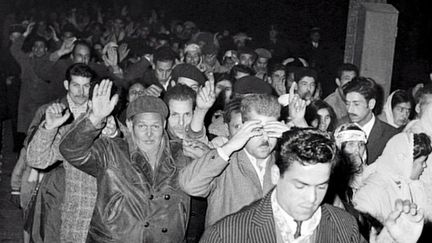
On the night of October 17, 1961, in Paris, the Seine, a river once mythical for writers and poets, became the silent tomb of hundreds of Algerians living in France who had peacefully come out to demand the right to dignity. Sixty-four years later, the memory of this tragedy, orchestrated by the notorious Police Prefect Maurice Papon, still haunts consciences.
What was meant to be a peaceful march against injustice turned into a massacre decided at the highest levels of the State. A cold-blooded State crime carried out by the Paris police, under the orders of a prefect known for his collaborationist past during the Vichy regime and later for killing Algerians while serving in Constantine.
That Tuesday on October , official France, which claimed to be the “homeland of human rights,” revealed the brutal face of its fading colonial empire. For that night of bloodshed was not a “slip-up,” but rather the continuation of a system based on the denial of the other, on the contempt for a people that it had claimed to “civilize.”
It all began with a discriminatory curfew, agreed upon by the government and the presidency of the Republic. On October 5, 1961, Police Prefect Maurice Papon imposed a measure reserved solely for “Muslim French citizens from Algeria”: a ban on moving about after 8:30 p.m. in Paris and its suburbs. Humiliating and arbitrary, this curfew sparked the anger of the Front de libération nationale (FLN), which called for a peaceful march to protest against this segregation from another era.
On the evening of October 17, 1961, some 30,000 Algerians, according to reports from the Amicale des Algériens de France, mostly workers, students, fathers, veiled women, and children, came out from the slums of Nanterre, Gennevilliers, and Saint-Denis, dressed in their Sunday best. They headed toward the center of Paris, sometimes carrying a flag, but unarmed and without violence. They simply wanted to show that they existed, that they were human beings. But the authorities’ response was ruthless. As night fell, the city became a stage of horror.
The police struck, fired, and raided. Some protesters were executed on the spot, others beaten to death in police stations or thrown, still alive, into the Seine. Witnesses recount the Seine running red with blood, the cries of the wounded, and the bodies floating between the bridges of Paris. The official, deceitful toll spoke of “three deaths.” Historians, however, speak of more than a hundred victims, perhaps up to two hundred, not counting the disappeared. There are 302 dead, including about forty drowned in the Seine, over 1,800 injured, and at least 12,000 protesters arrested.
This crime, nevertheless committed in the heart of the capital of the “free world,” was immediately covered up. The French press, under pressure from the authorities, remained silent or downplayed the facts. The few journalists who tried to bear witness, such as Claude Bourdet in France-Observateur, were threatened. The striking photographs were confiscated. In the days that followed, Algerian families desperately searched for their loved ones.
Hundreds of men never returned. Sometimes a body was found floating in the Seine, sometimes nothing at all. Official records lied, police stations destroyed evidence. The Republic, quick to preach moral lessons, covered up a premeditated State crime, organized and assumed by the police hierarchy.
For more than three decades, the truth remained buried under silence and fear. The French authorities maintained the fiction of a mere “incident.” Schools did not mention it, the media forgot, and the archives were locked away. It was not until the end of the 20th century that the heavy silence began to crack.
It is thanks to the persistent work of historians and activists such as Jean-Luc Einaudi, Jim House, Benjamin Stora, and Jean-Paul Brunet that the truth begins to emerge. In 1991, Einaudi published *La Bataille de Paris*, the result of years of investigation and gathering of testimonies. He describes a methodical repression, ordered from the top of the prefecture, and disproves the thesis of a “slip-up.”
In 1998, during the trial of Maurice Papon for his role in the deportation of Jews under Vichy, the historian testified as a witness. Facing justice, he declared: “On October 17, 1961, the Paris police killed on orders.” His research was later confirmed by the partial opening of archives, which proved the implementation of planned repression.
The historians’ work also reveals the extent of the lie, with hundreds of anonymous bodies hastily buried in mass graves or recovered without identification. October 17 was a colonial war imported into the heart of Paris. For Algerians, the massacre of October 17 was but one link in a history of colonial violence. Before Paris, there was Sétif, Guelma, and Kherrata in May 1945: thousands of civilians massacred by the French army for demanding freedom. There were also tortures in camps, summary executions, burnt villages, and mass deportations.
France claimed to bring “civilization,” but in 1954, more than 90% of Algerians were illiterate. A century of domination had brought neither schools, nor hospitals, nor dignity. This system of exploitation, based on segregation and injustice, could only end in bloodshed.
And it was this same colonial spirit, this same brutality, that was expressed in Paris, the City of Light, in October 1961. The “country of human rights” then had hands stained with the blood of a people it claimed to educate.
It was not until 2012, more than half a century later, that a French president finally mentioned the repression of October 17. François Hollande declared that “on October 17, 1961, Algerians were killed during a bloody repression.” His words were sober, measured, without naming the responsible party or using the term “State crime.” It was a partial, almost administrative recognition.
In 2021, for the 60th anniversary of the massacre, Emmanuel Macron took a further step. At a ceremony at the Bezons bridge, he paid tribute “to the victims of an inexcusable crime for the Republic.” He observed a minute of silence and laid a wreath. But he stopped there: no official apology, no legal recognition, no compensation. The president rejected the term “repentance” in the name of a “desire for national unity.”
Historian Benjamin Stora, in his report on the memory of colonization, considers that recognition is “a necessary but still incomplete path.” He stresses that the refusal to confront the past prevents France from building a peaceful memory. Despite symbolic progress, some voices in France continue to deny or downplay the facts. Political leaders, especially on the right and far right, denounce “unnecessary guilt-tripping.” Some even question the number of victims or justify the repression by citing the “violence of the FLN.” This attitude reveals the difficulty, or even refusal, to assume responsibility for a colonial system that deeply marked French society.
Yet the facts remain. Archives, testimonies, judicial investigations, and academic studies converge: October 17, 1961, was a planned, covered-up, and assumed State crime that was then erased. Today, in both Algeria and France, the memory of October 17 endures. In Paris, commemorative plaques recall the tragedy, notably the one at the Saint-Michel bridge, inaugurated in 2001. Associations like *Au nom de la mémoire* continue to organize marches and tributes. In Algeria, every October 17 is a day of remembrance, embedded in the national memory as an act of resistance and dignity.
Acknowledging this past is not about reopening wounds, but preventing them from closing over a lie. It is about doing justice to the dead, and to history. For the blood of Algerians spilled on the streets of the “land of human rights” does not demand vengeance. It demands truth and recognition, especially in French school textbooks.