

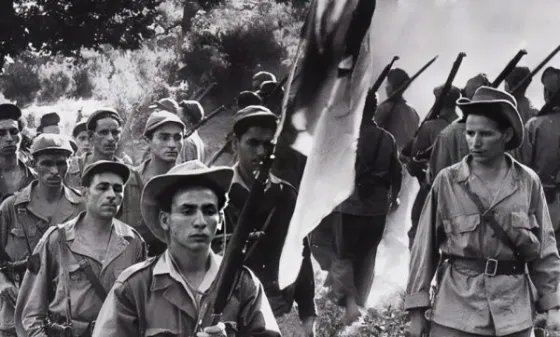
Sixty-nine years later, the stakes of the Soummam Congress remain as relevant as ever. As the armed revolution, launched on November 1, 1954, painfully neared its second year, the leaders of the National Liberation Front knew that resistance to colonialism had to be rigorously organized to endure over time. The strategic objective was above all to unify the ranks.
For the FLN strategists, the watchword was simple: one revolution, one voice! For the tandem Abane Ramdane-Larbi Ben M’Hidi, it was first necessary to convince and rally all national political forces around the idea of independence, then to organize and structure the struggle on the military, political, logistical, and diplomatic levels, and finally to impose a single interlocutor in the face of the enemy.
It is undoubtedly this colossal program that enabled this congress to succeed and become the cornerstone of this fighting Algeria. It was also this congress that paved the way for the restoration of national sovereignty, to use the words of historian Mohamed El Korso.
The architects of the platform had analyzed the declaration of November 1, its scope, and its limitations. They took a critical and objective look at this nascent revolution, assessing the means and potentials of the struggle.
Above all, they highlighted their rejection of personal ambitions, individualism, sectarian and clannish spirits, and divisions, both outside and inside, that were forming around the initiators of the revolution.
It is thanks to this congress that the other Algerian political forces joined the revolution. The UDMists, the centralists, the communists, the Muslim reformists, the autonomous intellectuals, and even some Messalist cadres and activists, all found in this platform a point of patriotic rallying and a unifying spirit.
For the delegates to the Soummam Congress, there are two major points to build and defend: firstly, to organize the revolution, structure the fighting base, and provide it with the means to fight. It was here that the FLN created the six wilayas, plus the autonomous zone of Algiers, commands and councils, appointed chiefs and commissioners, and launched new forms of resistance organization in the countryside, but also in urban areas.
Secondly, to impose the famous primacy of the political over the military and that of the interior over the exterior. This is a strategic postulate that Abane had conceived after having known and suffered the pangs of division, diversionary maneuvers, and the leadership attitudes of certain officials.
And it is undoubtedly this that later provoked his assassination by his own companions, panicked at the idea of losing privileges or power.
For the historian Mohamed El Korso, the victory of the Congress was “de facto” that of Abane, whose “leitmotif was unity in the struggle, which involved widening and opening the militant and fighting base of the FLN to all anti-colonialist national forces.
Even the Christian and Jewish communities were asked to contribute to the liberation struggle. In this sense, it is important to recall the words spoken by Abane to Ferhat Abbas when he told him: “the FLN belongs to no one, but to the people who are fighting. The team that launched the Revolution has not acquired any right of ownership over it.
If the Revolution is not the work of all, it will inevitably fail.” Today, it seems clear that these ideas of sovereignty and primacy are once again hovering over national political life. They still resonate, as during the Hirak last year, as a perpetual discourse of popular and citizen demand.