

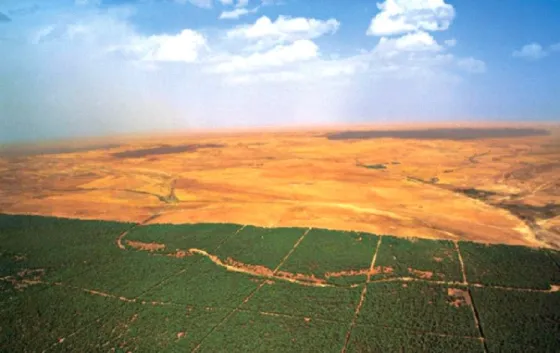
The Secretary-General of the Ministry of Agriculture, Rural Development, and Fisheries, Hamid Ben Saâd, chaired a working meeting on Thursday at the ministry headquarters dedicated to monitoring the development and expansion of the Green Dam. The meeting allowed for a review of the progress of operations included in the 2025 program, as well as the presentation of the action plan for 2026.
On this occasion, Mr. Ben Saâd emphasized the need to implement all practical and organizational measures to ensure the launch of the 2026 program on schedule and its completion under the best conditions. He also called for intensifying efforts and strengthening coordination between the various stakeholders in order to achieve the set objectives. The main stakeholders took part in the meeting, namely the Director-General of Forests, the Chairman and CEO of the Rural Engineering Group (GGR), the High Commissioner for Steppe Development (HCDS), as well as sector executives, representatives of the Directorate-General of Forests, and the National Office for Studies on Rural Development (BNEDER).
Recalling the strategic importance of the Green Dam, the Secretary-General of the Ministry stressed that it is a priority project for the country’s high authorities, due to its major environmental and economic impacts.
Since its relaunch in October 2023, the project has already achieved significant progress, including the planting of more than 21,000 hectares, the development of 376 kilometers of rural and agricultural tracks, the creation of 80 water points, as well as torrent correction over an area of 35,400 m2, according to the Directorate-General of Forests (DGF). In addition, 16,400 hectares of land have been protected to rehabilitate the steppe rangelands, which represent a large part of the Green Dam area.
This project also relies on the development of hardy species adapted to difficult climatic conditions, such as the argan tree, which is one of the major focuses of the Ministry of Agriculture’s five-year plan.
As part of the national strategy for the development of this plant, the DGF has planned the planting of 238,325 argan trees in the six main wilayas concerned by this program: Tindouf, Béchar, El-Bayadh, Nâama, Mostaganem, and Chlef, aiming to strengthen biodiversity and the local economy.
Beyond its crucial role in soil rehabilitation, the Green Dam also contributes to improving the living conditions of rural populations, through the implementation of essential infrastructure such as water points, the opening up of isolated areas, and the sustainable management of natural resources.
Designed according to new principles linking sustainable development, the fight against desertification, and adaptation to climate change, the revival of the Green Dam rehabilitation project is fully in line with the international agreement on sustainable land management, the reduction of sand and dust storms, and resilience to drought.
It is also part of the “Bonn Challenge,” a global effort to reforest degraded and deforested lands, as well as the Sustainable Development Goals (SDGs) that aim to restore 350 million hectares of degraded forest land by 2030, thus contributing to an environment conducive to wealth creation, economic growth, food security, and social stability.