

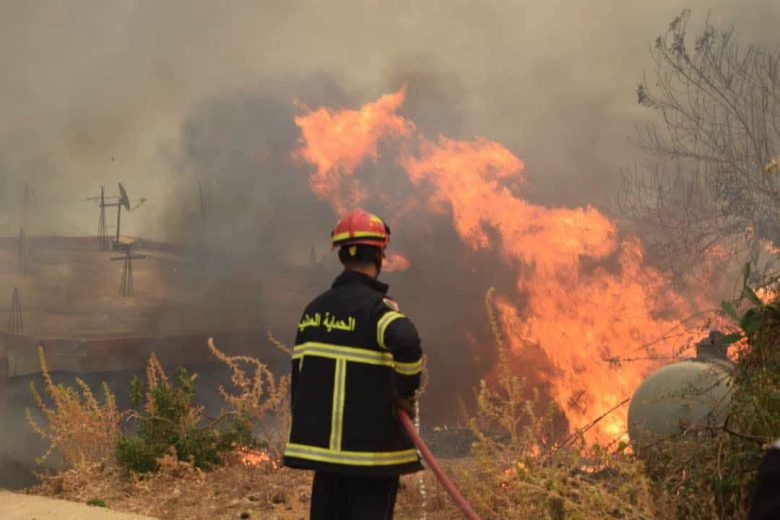
While several fire hotspots have been controlled across affected provinces, the Civil Defense urges maximum vigilance, strict compliance with evacuation orders, and immediate reporting of any new outbreaks, particularly in areas where shifting winds could trigger sudden fire resurgences. Lieutenant-Colonel Nassim Bernaoui, Deputy Director of Communications and Statistics at the General Directorate of Civil Defense (DGPC), outlined these warnings in statement.
Lieutenant-Colonel Bernaoui explained that peak summer conditions persist alongside ongoing forest fire risks, making caution essential. Citing operations in Jijel, he noted that following a temporary lull, shifting winds accelerated flame spread, particularly near residential zones.
He confirmed that coordinated operations involving Civil Defense, security services, and local authorities successfully evacuated multiple families as a precaution. “Certain families were evacuated when flames approached residential areas. Once danger subsided, some returned home, but caution remains critical,” he specified.
In Jijel, terrain features significantly complicate operations. Numerous homes are situated deep within or adjacent to dense forest tracts, often scattered and difficult to access. “The main challenge arises when fires advance toward populated sectors. Homes are widely separated, and certain areas lack sufficient access roads for rapid response or swift evacuation,” he explained.
Under such conditions, rapid public response remains critical. Bernaoui urged residents to follow official instructions immediately rather than waiting for situations to turn critical. “When an evacuation order is issued, compliance must be immediate. In wind-driven wildfires, available response time can prove extremely short,” he emphasized.
Special attention must be given to elderly individuals, dependents, and citizens with chronic health conditions, with protective relocations planned early. “Vulnerable populations must be evacuated first. Actions should not wait until flames reach immediate surroundings,” Bernaoui stressed.
The lieutenant-colonel further warned against smoke inhalation hazards and advised citizens against approaching fire zones to attempt independent firefighting. “The safest reaction is alerting emergency services rather than risking unnecessary exposure. Wildfires are difficult to contain and can evolve violently,” he recalled.
Youth seeking to support emergency teams were also instructed to remain within organized frameworks. “While public solidarity is appreciated, individuals wishing to help must remain alongside active response teams and strictly follow directives,” Bernaoui stated.
Substantial Operational Resources Deployed
The spokesperson confirmed that Civil Defense maintains a massive operational presence in Jijel province, supported by units dispatched from multiple regions nationwide. Lieutenant-Colonel Bernaoui indicated that “Jijel received significant reinforcements, particularly from Bejaia and other provinces.”
This deployment was pre-positioned based on weather forecasts. Mobile columns and regional support detachments were placed on high alert to respond rapidly to threatened sectors.
The operational force deployed in Jijel exceeds 560 personnel and 56 firefighting vehicles, supported by aerial assets.
AT-802 aircraft operated by Civil Defense, along with National People’s Army aircraft, were engaged to target major hotspots and fires located in inaccessible terrain. Lieutenant-Colonel Bernaoui noted that “aerial assets allow interventions on distant or ground-inaccessible hotspots, complementing the work carried out by ground crews.”
This reinforcement strategy extended across eastern provinces, including Jijel, Bejaia, and neighboring sectors, as part of a system designed to anticipate weather changes and rapidly concentrate resources where required.
Nationally, the situation is assessed as overall stable. Response crews continue monitoring affected sectors to extinguish residual embers and prevent re-ignition.
For Civil Defense, stabilizing conditions does not signify an end to risk. High temperatures, dry vegetation, and shifting winds continue to present conditions for rapid fire spread.
“We must remain ready to intervene at any moment, whether for new firefighting operations or to protect and evacuate populations if required,” Lieutenant-Colonel Bernaoui concluded.