

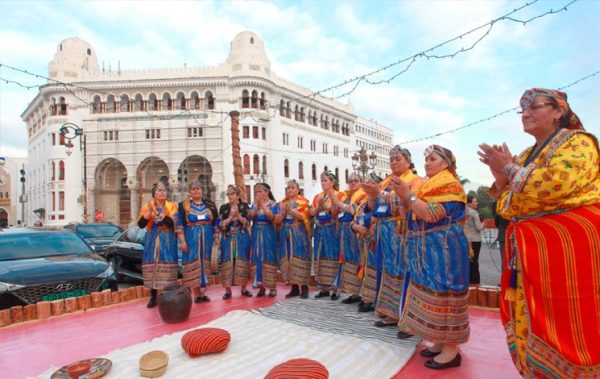
Under a clear but biting winter sky, Algiers’ Grande Poste square pulsed this Monday to the rhythm of an ancestral festival that has become a national gathering. From the earliest hours of the day, hundreds of citizens converged on this iconic downtown landmark to celebrate Yennayer, the Amazigh New Year, now firmly etched in the official calendar and collective consciousness as a symbol of unity and cultural diversity.
As the day progressed, the esplanade at the heart of the capital came alive, gradually transforming into a vast space for encounters, transmission, and sharing, where generations, regions, and cultural diversity mingled. Adorned with craft stalls and artistic installations, the vibrant colors of traditional attire contrasted with the white facade of the historic Moorish building.
Entire families, often with their children, crowded around long tables set up for the occasion, offering Yennayer’s emblematic dishes like couscous with seven vegetables, dates, dried fruits, honey, and traditional flatbreads. These foods carry deep symbols of abundance, prosperity, and renewal.
Mohamed Amine, director of the Office for the Promotion and Animation of Culture in the Algiers-Center municipality, told Le Jeune Indépendant that “this 2976 edition fully illustrates the cultural blending that characterizes Algeria,” adding that “it reflects the richness of our heritage and the cultural diversity that makes our country unique.”
He also highlighted that this year stood out with the revival and expansion of the “popular gatherings,” these revisited folk vigils that saw notable evolution compared to the previous edition. He explained that, extended to several regions of the country, they offer “a living image of coexistence and national unity,” confirming that Yennayer is a unifying festival open to all Algerians.
Throughout the afternoon, the square echoed with the sounds of drums, songs in Tamazight, and collective dance steps. Stage animations alternated musical performances, folk demonstrations, and speeches from associations, while storytellers brought to life foundational tales linked to Yennayer and the Amazigh calendar.
To the beat of the Idabalen percussion, groups of young people in traditional costumes performed ancestral dances amid enthusiastic applause from the crowd. Bilal, one of the dancers and a student at the University of Algiers, said enthusiastically, “For us, it’s a way to keep a tradition alive that’s part of our identity.” He added with conviction, “No matter where we come from, Yennayer reminds us that we share the same history.”
From the Biskra province, a folk troupe captivated the audience with a colorful performance. “Yennayer doesn’t belong to one region alone; it unites all of Algeria’s regions,” one member affirmed while presenting chakhchoukha, an emblematic dish from his region.
Dalila, a member of Algiers’ Houaa cultural association, shared that the main goal of this event remains the preservation and transmission of national heritage, noting that the association honored three provinces represented this year. She explained that Bouira province participated through an exhibition of traditional pottery, illustrating objects once used in ancestral homes, accompanied by a model of the first Kabyle cradle and an ancient plow.
Exhibitors from the Ath Ouacif region in Tizi Ouzou province offered a living tableau retracing the daily activities of Kabyle women, particularly wool work from processing to preparation for weaving, accompanied by ancestral women’s songs. The displayed fabrics featured highly symbolic colors: yellow for the Sahara, green for the mountains, and blue for the sea.
El Bayadh province, through the Bousemghoun region, enriched the event with poetry recitals and Amazigh songs. Dalila added, “This year, we also offered a screening dedicated to Amazigh traditions, so these practices endure over time and are passed on to new generations.”
Children at the Heart of Transmission
Very present throughout the day, children in traditional outfits held a central place in the celebration.
The children moved freely among the animations, grabbing pouches of nuts, dates, and sweets—symbols of the abundance wished for the coming year. Nearby, storytellers and a puppet show shared Amazigh heritage legends in a warm atmosphere, surrounded by an attentive crowd.
Assirem, 8 years old, dressed in a fuchsia Kabyle dress, confided with sparkling eyes full of joy, “I love Yennayer because we dance and eat together.”
Beside her, Nabil, 10 years old, proud of his spotless burnous, chimed in: “I really enjoyed the drawing workshop and the puppet shows. Here, we understand better why this festival is important.”
In this cultural dynamic, Safia, representative of the Karakusa association, emphasized the essential role of associations in promoting and preserving intangible heritage. She highlighted the organization of educational activities and workshops for children, including drawing sessions and traditional pastry-making workshops like Algerian tamina. She stressed that “the goal is to pass on our cultural heritage to the youngest in an educational, fun, and interactive way.”
The festival was also marked by a performance from a troupe from Tamanrasset, whose Tuareg dances and songs transported passersby into a timeless interlude, allowing them to forget daily concerns for a moment and vibe to the rhythm of collective joy, in the hope of welcoming the new year under good auspices.
Fascinated by the sword dance spectacle, Amine shared, “This is a moment I look forward to every year.” “We come as a family, we exchange, we explain to the children. It’s not just a festival; it’s a transmission. We’re also fascinated by the displayed objects from different regions of the country, each telling a story of our heritage,” he added.
A few steps away, Djouher shared the same sentiment. “Yennayer is not just the start of a new year. It’s proof that our culture is alive, evolving, and uniting beyond regional origins,” she affirmed.
Rituals, Gastronomy, and Collective Memory
The celebration extended below the esplanade, in the basement lined with fouta fabric featuring striped and geometric patterns, typically in vibrant, contrasting colors like red, yellow, black, and fuchsia, with touches of silver or gold.
Visitors discovered a rich array of artisanal and gastronomic products there. Traditional cakes, bread baked on site, honey, olive oil, but also pottery and traditional clothing like taguenourt, Kabyle dresses, embroidered shawls. Burnouses and local outfits offered visitors a true immersion in the richness and diversity of national heritage. Kabyle jewelry, such as ibzimen (fibulas), tabzimt (large pectoral fibula), azrar (necklace), ameclux (bracelet), thaxathemth (ring), tigetumin (earrings), and taessavt (forehead jewel), stands out for its beauty and symbolic richness. Crafted from finely chiseled silver, they are adorned with red coral and multicolored enamels that illuminate each piece, testifying to the meticulous craftsmanship of the artisans.
Among the participants, Nacéra from Tizi Ouzou province busied herself preparing kesra, a traditional flatbread made with olive oil. With a radiant smile, she assured, “We’re happy to be here to showcase the dishes from our region.” Visitors were invited to taste several local specialties for free, including couscous, trida, tekerbabin, and other dishes known by different names depending on the regions.
Nacéra also mentioned the trez, an ancient ritual involving pouring a mixture of dried fruits and candies over the youngest family member as a sign of blessing, prosperity, and joy. She added playfully, “Even when the children grow up, we sometimes continue the gesture, out of attachment and to preserve its symbolic meaning.”
For her part, Fatiha, an exhibitor from Tlemcen province, felt that “participating in this kind of event shows that Algerian customs and traditions, though diverse in form, remain deeply coherent and similar in essence.” Representing the Beni Snous region specifically, she explained that Ayrad, the local name for Yennayer, means “lion,” referring to courage and strength. “On this occasion, we prepare traditional dishes like couscous in red sauce with seven vegetables or legumes, symbols of the earth’s generosity,” she said. There’s also cherchem, a mix of wheat and fava beans, which holds a central place. Other emblematic dishes like msemen, baghrir, and mbessess enrich the decorated tables, not forgetting the indispensable khobza helwa, a sweet bread also called qarisa, topped with an egg in the center as a symbol of a sweet year full of prosperity and fertility.
The gastronomy is complemented by the Ayrad carnival, a semi-theatrical spectacle that animates the streets, where participants disguise themselves, parade, and sing popular songs. She emphasized that the fundamental goal of this exhibition remains the preservation of national cultural heritage and the faithful transmission of traditions handed down by ancestors.
At the end of the day, as the last songs faded on Grande Poste square, one certainty emerged: Yennayer has established itself as a national rendezvous, carrying memory, transmission, and cohesion.
Through this celebration, Algeria once again showed an image of itself true to its diversity, united around a shared heritage and looking to the future, under a single wish shared by all generations: Assegas Ameggaz 2976.