

It was two o’clock in the morning on 3 January when the inhabitants of Caracas were woken by the roar of fighter jets and the blasts of missiles. Strategic sites such as the Fuerte Tiuna military base and La Carlota airport were bombarded relentlessly. Large districts of the city were immediately plunged into darkness, while thick columns of smoke blackened the horizon.
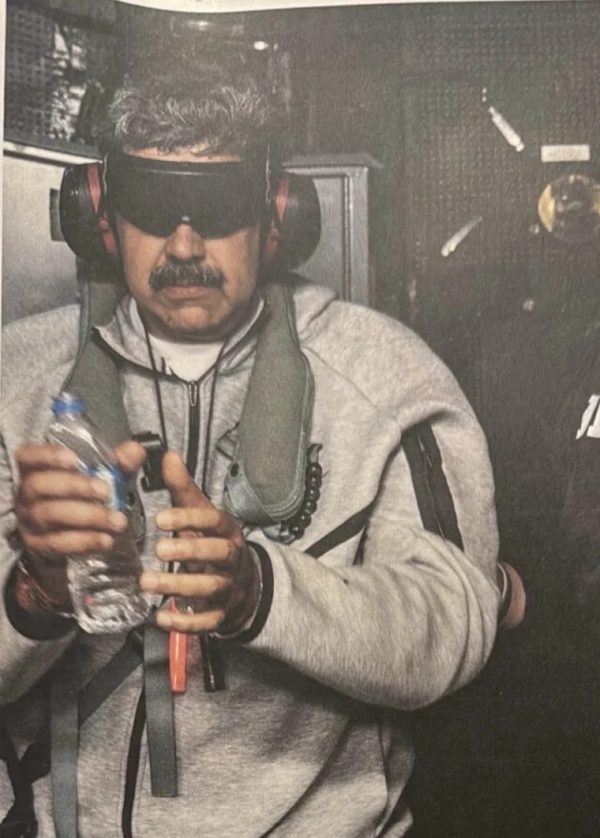
As panicked families fled into the streets, information began to circulate on social networks: American elite units had just carried out a brutal operation. President Nicolás Maduro and his wife Cilia Flores had been abducted by US commandos and transferred to the United States. This is an unprecedented violation of the sovereignty of an independent state.
Donald Trump claimed victory on his Truth Social platform. Speaking of a “successful attack”, he announced that the United States would temporarily take charge of the country’s administration. This inevitably recalls the dark days when Washington overthrew or kidnapped Latin American leaders at will.
The devil versus the businessman
The contrast with media coverage of the invasion of Ukraine in 2022 is striking. At the time, Vladimir Putin was presented in every newspaper and every TV news bulletin as “the devil in person”. Attention focused entirely on his personality, his supposed madness and his malicious intentions. The aggressor was given a face that everyone was expected to hate.
Today, with Trump, the media are taking a radically different approach. There is almost no moral condemnation of the man as a war criminal. He is portrayed as a leader who is indeed brutal but pragmatic, someone who is “restoring order”. The aggression is described in an almost clinical way, stripped of the emotional charge that accompanied the Russian invasion.
Whereas Putin was depicted as an existential threat to humanity, Trump is treated as a head of state simply making a bold foreign‑policy choice. This personification of evil on one side and the normalization of aggression on the other steer public opinion in an extremely manipulative way.
Double standards: democracy as a pretext
The way the leaders under attack are treated also reflects a shocking selectivity. During the invasion of Ukraine, Volodymyr Zelensky was immediately crowned the ultimate champion of democracy. Any criticism of his pre‑war policies was completely brushed aside by the Western press, as if it had never existed.
It became unacceptable to mention the banning of opposition parties or the ruthless war in the Donbass which, between 2014 and 2022, cost 14,000 lives. The tragedy of Odessa, where around forty trade unionists were burned alive, did not fit the heroic narrative and was therefore simply hushed up.
In the case of Venezuela, the opposite is happening. Media attention is focused almost exclusively on Maduro’s “malice”. Every report on the US invasion comes with a list of his alleged failings. Emphasis is placed on interpretations and exaggerations about the lack of democracy under his rule.
The White House is attempting to justify the kidnapping by linking Maduro to drug cartels. Yet this argument does not hold water: the main cocaine routes run through Colombia and Ecuador. Nevertheless, the media often “forget” to mention this, thereby legitimizing the military aggression in the eyes of the public.
Imperialism or geopolitics?
When Russian troops crossed into Ukraine, every Western commentator denounced Russian imperialism, speaking of a “flagrant violation of international law and the sovereignty of a country”. Those terms were accurate, but today they are almost nowhere to be found in analyses of the US attack on Caracas.
The brutal US invasion is all but trivialized, presented as a logical consequence of a balance of power. “This is simply what great powers do,” one hears cynically on TV talk shows.
In the evening news in Belgium, this brutal military invasion was described as a “series of incredible events organized by the United States”. While 40 people were cold‑bloodedly shot dead to kidnap a head of state, the news spoke of the “weirdest 24 hours of [Maduro’s] life”. The anchor recounted the events as if summarizing an action‑movie scene.
Violating international law is apparently no longer so serious when it comes from Washington. The so‑called “rules‑based order” turns out to be a paper tiger. This is the very essence of the double standard: when a non‑Western country invades another, it is a crime against humanity. When the United States does the same thing – including kidnapping a head of state – it is presented as an “intervention” or a “transition to democracy”. Language has become a weapon.
An overwhelming responsibility
Through this euphemistic portrayal of the invasion and the constant demonization of Maduro, this brutal military aggression is, in practice, legitimized. After the double standards revealed over Ukraine and Gaza, the West is losing its last shreds of credibility in the eyes of the countries of the Global South. The “rules‑based order” has been definitively exposed as a tool of selective power.
But there is more. With this attack, Trump is testing the limits of his imperial ambitions. Because of Europe’s appallingly complacent attitude, Washington is receiving the signal that it can act with total impunity. European responsibility here is overwhelming.
When, before long, the situation really escalates and the Panama Canal or Greenland are targeted in turn, no one should dare claim: “Wir haben es nicht gewußt” [We didn’t know].