

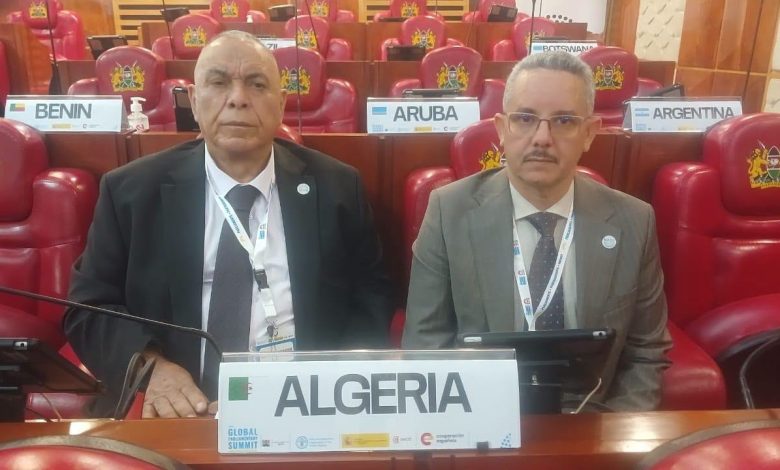
Algeria has showcased its social model as a bulwark against hunger and poverty, highlighting the role of subsidies, purchasing power protection, and parliamentary oversight in safeguarding the right to food at the third Global Parliamentary Summit against Hunger and Malnutrition in Nairobi, Kenya, while advocating for sharing successful national experiences to bolster global food security.
At the opening of the gathering, Belkacem Boukhari, chairman of the National Defense Committee at the Council of the Nation, presented the Algerian experience Monday evening, stating that “the social character of the state has helped guarantee complete nutrition for all citizens, without any discrimination.” Participating in the debates on behalf of the parliamentary institution, Algeria’s representative outlined the social and institutional mechanisms that have driven down hunger and poverty in Algeria, enabling it to occupy “an advanced standing at regional and international levels.”
Mandated by the President of the Council of the Nation, Azouz Nasri, the Algerian delegation also includes Hamed Khedraoui, rapporteur of the Committee on Health, Social Affairs, Labor, and National Solidarity.
In his remarks, Mr. Boukhari particularly underscored the weight of the state’s social choices in ensuring access to food. He noted that this orientation materializes through “sustainable social measures,” notably “price support for essential staples and tax relief on certain widely consumed foodstuffs.”
Within the approach presented in Nairobi, these mechanisms serve as vital levers to preserve purchasing power and keep food products affordable for the widest possible population. The lawmaker thus defended “a policy grounded in continuous public support” and “shielding citizens from economic hardships liable to jeopardize their access to basic necessities.”
The second pillar of the Algerian address focused on the responsibility of legislative institutions in consolidating food security. Mr. Boukhari recalled that Parliament’s action rests upon “a constitutional foundation guaranteeing the right to food,” asserting that “the Algerian Parliament counters, through its legislative and oversight powers, any attempt to infringe upon this fundamental right.” He detailed the instruments at its disposal, notably “passing agricultural laws, approving funding, and monitoring budget execution.”
The Council of the Nation representative also highlighted the punitive dimension of the legal framework, marked by tougher maximum penalties against perpetrators of environmental crimes, notably “forest fires,” alongside “the criminalization of illicit speculation and monopolistic trade practices.” Through these provisions, he underscored the broad scope of parliamentary intervention in protecting natural resources and preserving conditions for food access.
Call to Broaden the Algerian Experience
Beyond presenting domestic frameworks, the parliamentarian sought to lend an international dimension to his speech. Addressing the session chair, he raised the issue of scaling up proven national experiences and leveraging them in the fight against hunger and poverty. He thus asked participants about the feasibility of “generalizing such national experiences and capitalizing on them to eradicate the phenomena of poverty and hunger, or at least curtail them,” at regional and global levels.
Citing the Algerian experience as a benchmark, Mr. Boukhari stated that the nation stands squarely among countries that have succeeded in driving hunger and poverty down to their lowest levels, making a plea for cooperation allowing nations to benefit from social policies and legal tools developed elsewhere.
Notably, the summit’s opening ceremony took place in the presence of the President of the Republic of Kenya, the speakers of both chambers of the Kenyan Parliament, as well as the Deputy Director-General of the Food and Agriculture Organization of the United Nations (FAO).
Over two days, parliamentary delegations will examine three core themes. The first centers on the effective exercise of the right to food through inclusive development and social justice. The second addresses promoting access to and consumption of healthy diets. The third is dedicated to building inclusive, sustainable agricultural and food systems capable of withstanding crises.