

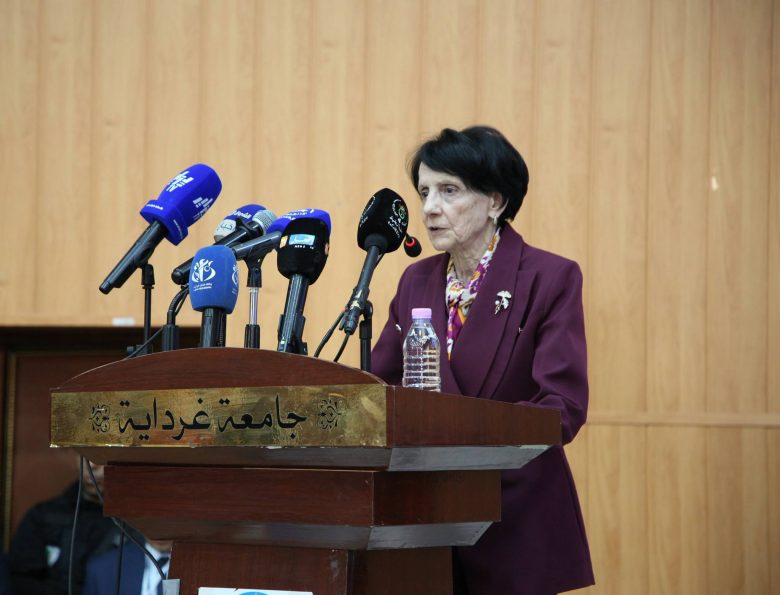
Legal certainty stands as an imperative in drafting legislation and safeguarding fundamental rights. The President of the Constitutional Court, Leila Aslaoui, urged on Tuesday in Ghardaia to enshrine this principle by enhancing the quality, clarity, and stability of statutory texts. She also stressed respect for fundamental rights and freedoms, alongside the constitutional boundaries framing the exercise of legislative power.
During the 4th symposium of the Constitutional Court, hosted at the University of Ghardaia in partnership with the United Nations Development Programme (UNDP), the president asserted that legal certainty forms an essential requirement in lawmaking, particularly regarding statutes affecting fundamental rights and freedoms, according to sources at the Constitutional Court.
Drawing upon the preamble of the 2020 Constitution, specifically its fifteenth paragraph, and its Article 34, she recalled that the state is bound to ensure citizens have access to legislative texts, alongside their clarity and stability. In this regard, she noted that legal certainty represents a cornerstone of social and economic security, insofar as it shields citizens from the fallout of convoluted legislation and preserves the stability of legal situations and acquired rights.
Regarding the prerogatives of Parliament, Leila Aslaoui recalled that “Article 114 of the Constitution grants it sovereignty in drafting and passing laws.” However, this authority, she explained, remains bounded by constitutional requirements, notably those stipulated in Articles 139 and 140 concerning legislative drafting quality standards and preserving the core of rights and freedoms when regulated by statute.
The Court President also pinpointed three factors liable to undermine legal certainty, namely “the complexity of legislative texts, the proliferation of laws and their lack of coherence, as well as their retroactive application,” according to the same source.
This scientific gathering offers, according to the same official, an opportunity to examine the complementary relationship among the Constitutional Court, Parliament, and judicial institutions in pursuing legislative quality and guaranteeing statutory stability.
The objective is to exchange viewpoints and debate key issues tied to the various powers of the Constitutional Court regarding reviewing the conformity of organic laws with the Constitution and overseeing the constitutionality of laws.
Leila Aslaoui further emphasized the participatory nature of this forum, which brings together members of the Constitutional Court, representatives from both chambers of Parliament, magistrates from the Supreme Court and the Council of State, UNDP experts, academic researchers specializing in law, as well as Bar Association representatives. The speaker noted that this approach, now a tradition at national and international scientific conferences organized by the Court, fosters the dissemination of constitutional culture and opens the institution to its academic and judicial surroundings.
The president additionally highlighted that this symposium takes place against the backdrop of the fifth anniversary of the Constitutional Court’s establishment, recalling the pivotal role of the 2020 constitutional revision.
Moreover, the same official commended the selection of Ghardaia, which hosts this symposium for the second time, spotlighting its cultural diversity and the richness of its architectural heritage. She recalled the inscription of five of its historic ksour on the UNESCO World Heritage list in 1982.
Evoking the historic significance of November in the course of the National Liberation Revolution, she quoted a verse by Moufdi Zakaria (1908-1977), dubbed the “Poet of the Algerian Revolution” and a native of Beni Isguen.