

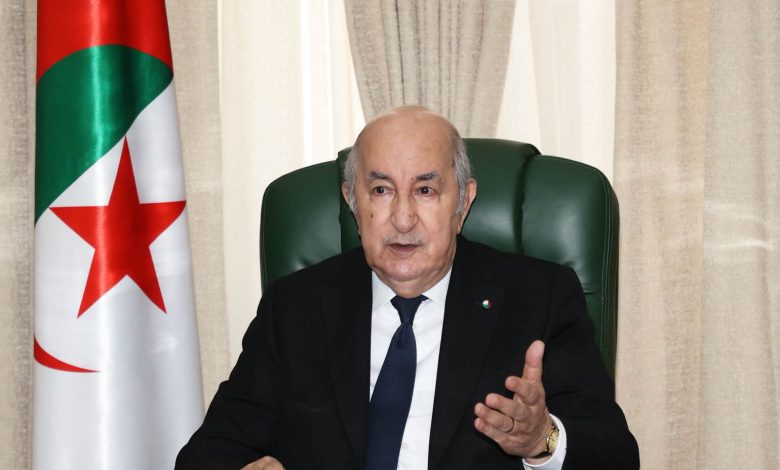
President of the Republic Abdelmadjid Tebboune highlighted on Saturday in El-Alamein key infrastructure initiatives undertaken by Algeria to strengthen connections across the continent and drive regional economic integration. Delivered on his behalf by Council of the Nation President Azouz Nasri, who represented him at the Summit of NEPAD (New Partnership for Africa’s Development) Founding Countries, the address spotlighted projects including the Trans-Saharan Highway, the Tindouf–Zouerate road link to Mauritania, southern rail network expansions, the trans-Saharan fiber optic spine, and the Trans-Saharan Gas Pipeline.
These projects, Tebboune noted, embody a strategic drive toward “economic convergence with neighboring states” while opening expanded horizons for cross-border trade and partnership. Linking Algeria with five neighboring nations, the Trans-Saharan Highway serves as a vital artery for transit, commercial flow, and cross-border investment.
The Head of State similarly pointed to the Tindouf–Zouerate road connecting Algeria and Mauritania alongside ongoing rail expansion toward southern territories. Complementing these land transport corridors, the trans-Saharan fiber optic network aims to enhance digital infrastructure across the Sahel, while the Trans-Saharan Gas Pipeline stands as a flagship energy and industrial development endeavor.
Human capital development remains equally central to Algeria’s regional commitment. Tebboune recalled that since independence, the country has trained tens of thousands of African professionals across various disciplines and continues to provide annual educational grants and scholarships to students from across the continent.
For the Algerian leader, such efforts transcend individual national achievements, serving instead as “building blocks toward a more connected and integrated African space” driving shared prosperity.
This vision anchors a broader reflection surrounding the future trajectory of NEPAD, twenty-five years following its creation. Tebboune called for drawing lessons from a quarter-century of collective African action and initiating a new phase centered strictly on project implementation and concrete outcomes.
He emphasized that the principal challenge now facing the continent lies in bridging the gap between stated aspirations and tangible field results. “The challenge before us today is to move decisively from planning to execution,” he declared, urging a transition from fragmented approaches toward high-impact structural projects.
For the President, genuine African ownership over development cannot rest solely on setting priorities. It must be paired with dedicated financing mechanisms, implementation channels, and evaluation frameworks capable of translating policy decisions into real-world progress.
==========Strengthening African Financial Institutions
Addressing funding challenges, Tebboune urged boosting Africa’s capacity to mobilize internal resources while steering continental capital and savings toward core development priorities. He further advocated strengthening African financial institutions and advancing efforts toward a more equitable global financial architecture that better reflects continental interests.
The private sector, he noted, must play an expanded role in driving investment, production, innovation, job creation, and the development of regional and continental value chains. The President called for improving business environments, deepening public-private partnerships, and deploying innovative financing tools.
Ultimately, these mechanisms must yield actionable, bankable projects featuring clear timelines and measurable metrics. “Tangible impact on the daily lives of African citizens” must serve as the true benchmark of collective success, he stressed.
Tebboune also called for bolstering the African Union Development Agency (AUDA-NEPAD) to ensure it retains full operational capability. He advocated for a “stronger, more agile, and effective” agency backed by adequate financial resources and administrative support.
Additionally, he stressed reinforcing alignment between the Agency, the African Union Commission, and Regional Economic Communities while eliminating institutional overlap. “Our goal is not to multiply administrative structures, but to enable existing institutions to translate political directives into concrete projects and results,” he affirmed.
In the same vein, Algeria reaffirmed its backing for the establishment of an African credit rating agency, while calling for accelerated progress on key Agenda 2063 flagship initiatives and the full realization of the African Continental Free Trade Area (AfCFTA).
Marking NEPAD’s 25th anniversary, Tebboune concluded that the milestone must serve as both a moment of assessment and a catalyst for setting future priorities. He urged placing execution, resource mobilization, and impact assessment at the core of the African Union Development Agency’s mandate.
Algeria seeks to foster “more feasible and bankable” projects, more efficient institutions, higher mobilization of domestic resources, and fairer international partnerships.
Closing his message, the President called for making this anniversary “the threshold of a new era in joint African action,” grounded in self-reliance and the conversion of continental ambitions into concrete realities.