

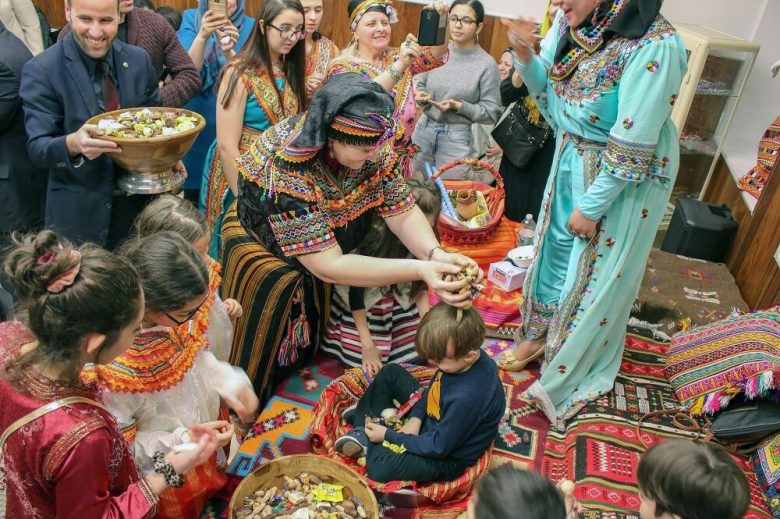
Tizi Ouzou province has always vibrantly celebrated Yennayer. This year too, the people of Tizi Ouzou did not break with tradition. At the Mouloud Mammeri Cultural House and its various annexes, a rich program was put together to give a special touch to the celebration of the first day of the Amazigh year 2976, corresponding to January 12, 2026, in the Gregorian calendar.
Indeed, at the Tizi Ouzou Cultural House, this Monday was marked by exhibitions of paintings and writings of high documentary value. In the same space, more precisely in the large performance hall, a large audience attended a women’s singing performance as part of the closing and award ceremony for the winning troupes of the 4th edition of the women’s folk song festival “Urar n Lxalat.”
At the Kateb Yacine Regional Theater, theater lovers were treated to the play “Caza Poubelle,” superbly performed by actors from the Youth Theater Association of Cheurfa village in Bouira province. Within the Si Mohand u M’hand Main Public Reading Library, the public also enjoyed exhibitions of artistic works and activities led by the cherubs from the “Au Trésor de Mes Parents” nursery.
At the Azazga annex, the public was treated to a staging of a “traditional wedding,” recitals of tales and songs performed by the Dhaouia Social Association of Ighil Tizi-Boa (Bouzguène). There was also a poetry recital animated by members of the poetry workshop led by Aït Gherbi Ouiza, as well as other women’s songs performed by members of the Tigejda Aït Bouada and Tizizwit Mhagga cultural associations.
For film enthusiasts, a screening of the film “La Montagne de Baya” by Azeddine Meddour was held at the Tizi Ouzou Cinematheque, followed by a conference on Amazigh cinema led by university specialists in film science and its history. In the Djurdjura cinema hall, the public also enjoyed a screening of the documentary “Cheikh El Hasnaoui” by Abderrazak Larbi Cherif, tracing the journey of the famous artist.
Still in Azazga, more specifically in its library space, this Monday before Yennayer was punctuated by discoveries of books on Berber history, culture, and civilization; a conference on Yennayer led by university scholar Takfarinas Naït-Chabane; a film screening; and the organization of a writing contest on Yennayer for middle school students.
In Djemaâ n’Saharidj, municipality and district of Mekla, the animation and intellectual curiosity around Yennayer were also on the agenda. On January 11, 2026, the program featured an exhibition of books related to “Berber history, culture, and civilization” from the library’s documentary collection; a conference on Yennayer led by Chebah Karima, a teacher at Mouloud Mammeri University in Tizi Ouzou; a dictation and Tifinagh writing workshop; a coloring workshop for children with Down syndrome; riddles and educational games; storytelling workshops led by Brachimi Titem and Fatima Gherab; creative work on greeting cards incorporating Berber symbols in collaboration with the Djemaâ Saharidj ASPROM and the Thala Kamera Down Syndrome Association. There was also a Yennayer quiz dedicated to Amazigh civilization, a theatrical performance titled “The Rooster” by Lisa Fraouti, and a major writing contest on Yennayer for middle school students. In Aïn El Hammam, the Yennayer celebration also highlighted its cultural and intellectual dimensions.
As for this Monday, it was marked by other activities closely tied to Yennayer. At the Mouloud Mammeri Cultural House, an artistic show animated by Hacène Ahres and Naïma Ramdani was scheduled, accompanied by a fashion show presented by the Taous Robe Kabyle house from Tizi Rached. In the province’s other cultural spaces, activity did not wane at all.
Finally, the large village of Redjaouna in the Tizi Ouzou municipality left its mark on Yennayer 2976. In addition to a rich cultural program, including a grand parade organized by and for children through the village streets, residents organized a louzia, also called “Timechrit.” The village committee called on all citizens to join a collective meal. According to information gathered by Le Jeune Indépendant, no fewer than 3,000 meals will be distributed to guests.
Moreover, the costs of this offering were entirely covered, at his request, by a wealthy village resident. Initially, each family was expected to contribute financially to this initiative, but once informed, the man decided to shoulder all the expenses himself.