

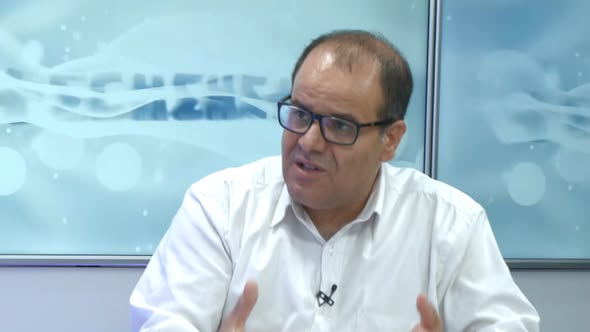
Ramdane Youssef Tazibt, former deputy and senior militant of the Workers’ Party (PT), issued a firm warning this Tuesday against the approach of the terrorist movement MAK, which, from its Paris exile, is preparing on December 14 to proclaim a supposed “independence” by inventing a non-existent political entity completely disconnected from the historical and human reality of the country.
In a long opinion piece published the day before yesterday on his social networks, the PT militant declared his rejection of any initiative in this direction and insisted on the “unity of the Algerian people.” From the outset, he strongly affirms that as Ramdane Youssef Tazibt, an “Algerian from Kabylie” and a “Tamazight activist,” a language he says he has defended since his youth, he has “mandated no one” to speak on his behalf about any “so-called independence,” a position he says is shared by “millions of Kabyles.”
He also recalls that Algeria “was torn from colonial yoke thanks to a united struggle of the Algerian people, regardless of language,” across different regions of the country. The PT militant emphasizes the continuity of the national independence movement in the 20th century which, in his own words, “carried the torch” by creating the North African Star in 1925/1926 “with naturally both Berber speakers and Arab speakers.” He mentions “ups and downs, mistakes and sometimes missteps” after that, but insists especially on “an unwavering determination and a deep-seated attachment to the unity of the people” against “colonial attempts to divide the people.”
Referring particularly to the war of national liberation, he recalls that “the blood of 1.5 million martyrs, as well as the 45,000 Algerians massacred in May 1945 […], were Arabophone and Berberophone alike.” In this sense, Mr. Tazibt argues that “now more than ever” Algeria needs “unity in linguistic and cultural diversity,” in an international context marked by “historic shifts.”
Mr. Tazibt then devotes a large part of his text to the MAK, which he bluntly describes as a “separatist” and “racist” movement, openly calling “for the disintegration of the nation.” He points out that in 2019, during the Hirak protests, attempts by MAK militants to form “squares” in the popular marches “met with a resounding failure.” He writes that “the Kabyles peacefully chased them away, notably in Tizi Ouzou and Béjaïa,” adding that its supporters “have never again set foot in the Friday marches.”
In the same vein, Mr. Tazibt stated that the MAK is currently “isolated, marginalized” and mainly based outside the country, where it benefits from “protection by Western powers (EU/United States).” He further recalls that the president of the movement, Ferhat Mehenni, “visited the Zionist entity” and marched in Paris “with Zionist flags,” even as “the entire planet shows support for Palestine, a victim of genocide.” The PT militant asserts that the presence of “diplomats from the Emirati entity,” with whom Ferhat Mehenni appeared at the UN headquarters, is no coincidence; Mehenni is “seeking support and funding at all costs.”
He also revisits the deadly fires of 2021 in Kabylie, declaring that “supporters of the MAK tried to prevent the human flood” coming from across the country to aid the victims. He writes that faced with this solidarity, “its supporters skulked in Kabylie, even where the grieving population appreciated the endless human processions arriving continuously […], having sensed a possible dirty trick by the separatists…” Mr. Tazibt believes that despite its weak militant base, the MAK constitutes “a formidable tool likely to be used by all imperialist powers and their henchmen” as a means of pressure or to harm the country’s “sovereignty,” “integrity,” and “unity.”
In a decisive tone, he affirms that on the national level, this situation requires calm, unity, and freedom in all fields.