

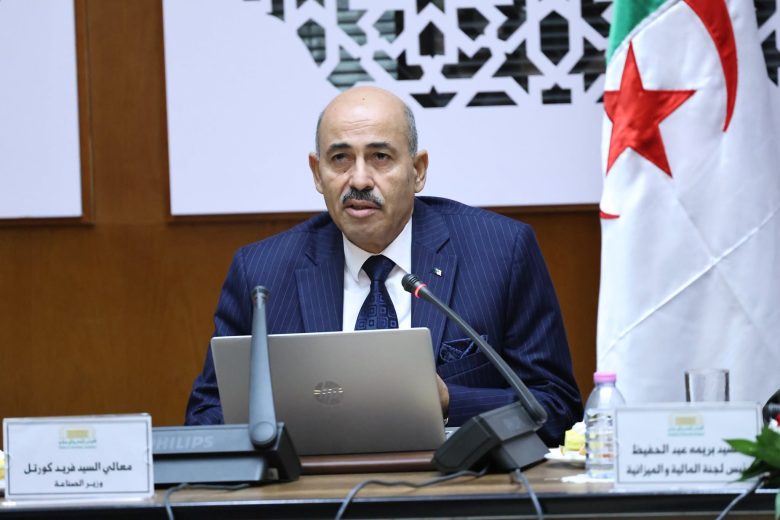
The industry sector will benefit in 2027, within the framework of the Finance Bill (PLF), from a budget of 40.54 billion dinars in payment credits and 7.13 billion dinars in commitment authorizations. Presenting Tuesday the main budgetary guidelines before the Finance and Budget Committee of the National People’s Assembly (APN), the Minister of Industry, Farid Kourtel, emphasized the completion of ongoing projects, the mobilization of industrial land, and the reinforcement of local integration, with the objective of bringing industry’s contribution to 13% of gross domestic product (GDP) next year.
The presentation, delivered as part of reviewing the 2027 Finance Bill, aligns with the implementation of directives from President of the Republic Abdelmadjid Tebboune, who placed tax reform and industrial revival at the core of national economic sovereignty. Agri-food, chemical, and pharmaceutical industries figure among the identified strategic sectors.
To achieve these objectives, the Ministry of Industry intends to act across six axes, notably completing and regularizing committed operations, removing constraints related to industrial land, developing subcontracting and local integration, strengthening infrastructure, promoting innovation and industrial property, as well as modernizing administrative management.
According to the minister, budgetary programming for 2027 favors finalizing operations already committed rather than launching new projects. Payment credits devoted to ongoing operations thus represent 96.4% of credits allocated to investment, compared to 0.5% for new operations, essentially limited to studies. This direction aims to rationalize public expenditure and ensure better control over public finances by accelerating the conversion of budgetary commitments into concrete realizations.
Industrial land constitutes another major lever of sector policy, with a target to reach 738.5 hectares of developed land in 2027, while accelerating the allocation of available plots. This approach requires advancing the development of zones that remain insufficiently equipped, in coordination with the Algerian Investment Promotion Agency (AAPI) and local authorities, to meet investor needs.
Raw Materials Exempted from Customs Duties and VAT
The 2027 Finance Bill provides a tax measure designed to support industrial subcontracting. It covers the exemption from customs duties and value-added tax (VAT) applied to components and raw materials, imported or acquired locally, intended for subcontractors in mechanical, electronic, and electrical industries.
This provision aims to reduce production costs for small and medium-sized enterprises (SMEs), improve their competitiveness against imported spare parts, and facilitate their access to prime contractor markets. The challenge is to convert this tax advantage into additional production capacity, skilled jobs, and contracts with Algerian companies.
This measure complements the provisions of the 2026 Finance Act, which provides, under certain conditions, the possibility to extend tax exemptions granted to investments and startups for up to two years.
It also fits into the momentum of reforming the investment single window, which relies on digitizing procedures, with processing times for files set at 25 days as a general rule and 20 days for classified infrastructure. Furthermore, the AAPI must respond within 48 hours to requests for economic land following a decision by its board of directors.
Focus on Quality and Innovation
Improving product quality and compliance constitutes an essential condition for accessing foreign markets. In this perspective, the sector aims to increase the number of accredited bodies from 8 to 25 and accredited companies from 33 to 62. Strengthening these capabilities will allow Algerian companies to better satisfy the requirements of African and international markets, particularly within the context of the African Continental Free Trade Area (AfCFTA).
Developing the SME network also ranks among the priorities. Beyond sheer numbers, the challenge involves boosting their modernization and facilitating their access to financing. The support program targets 200 SMEs initially, including 50 subcontracting firms.
In parallel, the ministry intends to turn innovation and industrial property into competitiveness drivers. The 20% increase in patent applications recorded in 2025 demonstrates growing interest in protecting innovations. Accompanying this momentum will involve startups, universities, and enterprises.
Additionally, modernizing administrative management will rely on continuing procedure digitization, controlling operating expenses, and improving budgetary execution.
Through these guidelines, the 2027 budget highlights better utilization of public resources, accelerating project completion, and removing constraints hindering productive investment, in order to strengthen national industrial capabilities, foster import substitution, and expand local value creation.